In many Singapore organisations, from SMEs to multinational headquarters, reporting lines are no longer straightforward.
You might find yourself leading a project with team members from three different departments, none of whom report to you.
Or you could be an individual contributor expected to secure buy-in from senior stakeholders across the region.
This is the reality of today’s cross-functional and matrixed workplace. Your job title often does not give you full control over resources or people. Yet you are still expected to deliver outcomes, meet deadlines, and drive decisions.
That is where influence without authority becomes essential. It is the ability to shape actions and priorities without relying on formal power.
For mid-level professionals in Singapore, whether in product, marketing, operations, or HR, this skill often determines who succeeds and who simply struggles.
In this article, we will look at practical ways to build workplace influence skills through credibility, relationships, strategic communication, and stakeholder alignment.
These are not abstract ideas. They are behaviours you can apply in your next cross-functional meeting.
Before we dive into the “how,” let us first clarify what influencing without authority actually looks like in a modern Singapore workplace.
What Influence Without Authority Means in the Modern Workplace
Influence without authority means getting things done through persuasion, trust, and competence rather than through formal power. In practical terms, you are not the boss, but you still move the needle.
Consider these familiar scenarios in Singapore offices:
- You are a project lead managing a cross-functional team from finance, IT, and operations. You have no hiring or firing power over them.
- You are an individual contributor in a matrixed organisation where you report to both a local manager and a regional director with different priorities.
- You are in a support function like HR or marketing, trying to get sales or product teams to adopt a new process.
In all these cases, waiting for permission or demanding compliance will not work. Instead, you need stakeholder influencing skills that help peers and managers choose to support you.
Why is this increasingly important in Singapore? Many local organisations have adopted matrix structures, especially in sectors like tech, finance, and logistics.
Reporting lines are indirect. Teams are distributed across Southeast Asia. And career progression now depends heavily on your ability to lead without a title.
Now that we have defined the concept, let us explore where real influence actually comes from when you have no formal authority.
The Real Sources of Influence at Work
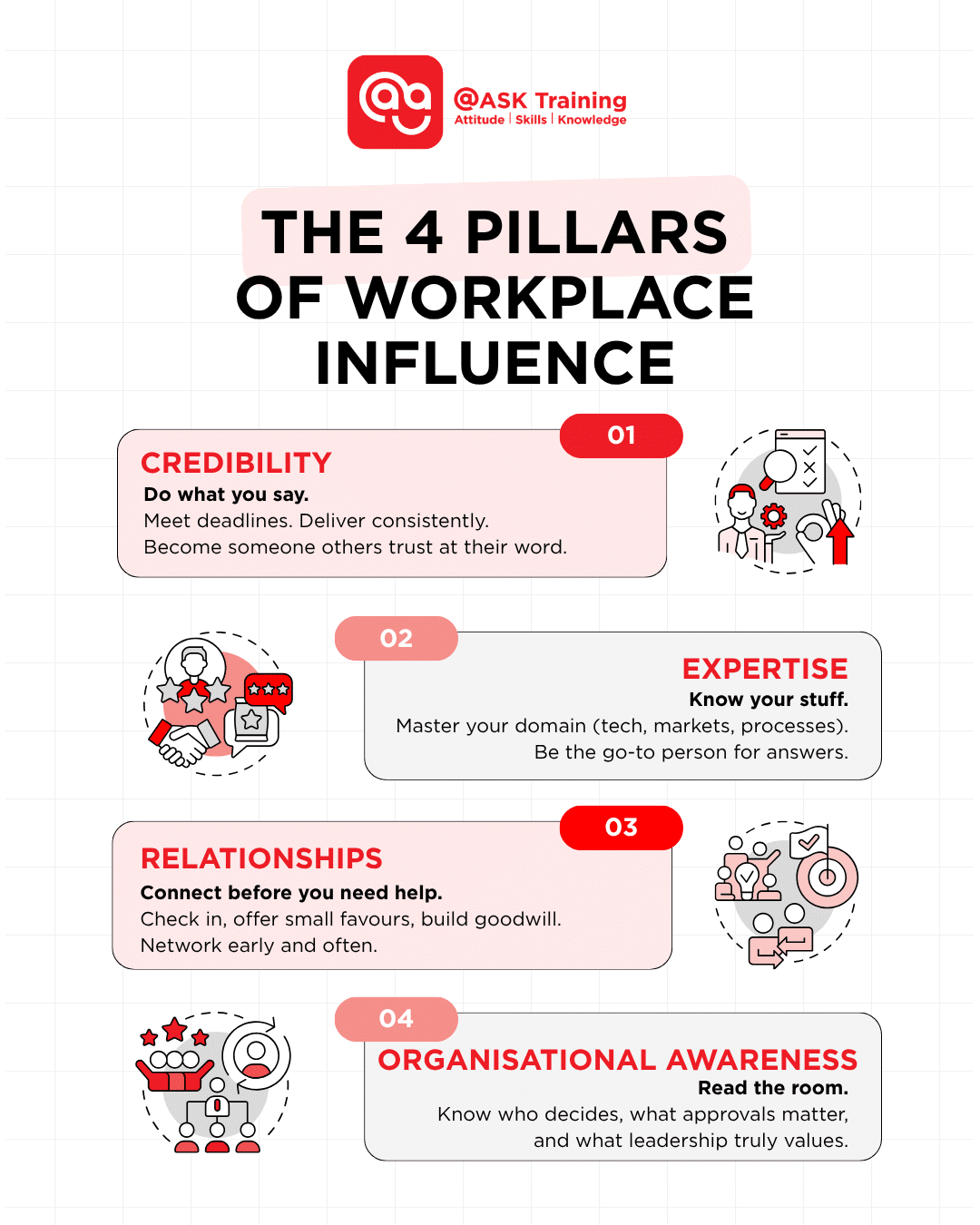
Influence does not come from a corner office. It comes from four practical sources that anyone can develop over time.
1. Credibility
- This is your reputation for delivering on promises. When you say a report will be ready by Wednesday, it is ready.
- When you commit to a deadline, you meet it. Over time, colleagues learn that your word is reliable.
2. Expertise
- This is the depth of knowledge you bring to the table. It could be technical skills, market insights, or process mastery.
- When people know you understand the subject better than anyone else, they naturally turn to you for direction.
3. Relationships
- These are the professional connections you build before you need a favour.
- Simple actions like checking in on a colleague’s priorities or offering help on a small task create goodwill that pays off later.
4. Organisational Awareness
- This means understanding how decisions get made in your company.
- Who are the informal gatekeepers? What approvals are truly necessary? What business priorities carry real weight with leadership?
In practice, this looks like:
- Being recognised as the go-to person for data analysis on your team.
- Consistently following through so others trust your recommendations without second-guessing.
- Knowing that a certain director cares more about cost control than speed, and framing your proposal accordingly.
These four sources form the foundation of leadership without authority. The good news is that none of them requires a promotion. They only require consistency.
With those foundations in place, the next question is how to turn them into actual influence over stakeholders. That is where relationships and alignment become critical.
Relationships and Stakeholder Alignment Make Influence Easier
You can have perfect expertise and strong credibility, but if you ignore stakeholder priorities, your ideas will still stall.
Influencing stakeholders without authority starts with understanding what actually matters to them.
In Singapore workplaces, where teams are often lean and targets are demanding, every stakeholder is managing their own pressures.
A finance manager is worried about budget overruns. An operations lead is measured on delivery speed. A regional director cares about quarterly numbers.
Your job is to connect your request to their goals.
For example, instead of asking an IT stakeholder for extra development time because “it would be nice to have,” you might say: “Allocating two more days to testing will reduce post-launch bugs by an estimated 30%, which lowers your team’s support tickets.”
Notice how the framing shifted from your need to their benefit.
Practical ways to build stakeholder alignment:
- Map your stakeholders early. Before presenting any idea, list everyone whose approval or cooperation you need.
- Understand their pressures. Ask yourself: What is their boss measuring them on? What keeps them up at night?
- Reframe your proposal. Show how your idea supports their team or company objectives, not just your own.
When you take this approach, you stop being seen as someone who creates extra work. Instead, you become a partner who helps others achieve their targets.
But alignment alone is not enough. You also need to communicate in a way that earns buy-in across different audiences. Let us look at how to adjust your style for each stakeholder group.
Communicating for Buy-In Across Different Stakeholders
The way you speak to a peer is different from how you present to a senior director. Soft skills influence requires adapting your message based on who is listening.
For Peers and Teammates
Focus on collaboration and shared goals. Use “we” language. Ask for their input early. People support what they help create.
For Managers and Department Heads
Focus on options and trade-offs. Present two or three paths forward, along with the pros and cons of each. Let them feel they are making the decision with your guidance.
For Senior Leaders and Executives
Focus on outcomes, risks, and business impact. They care less about process details and more about results. State your recommendation clearly, then back it up with data.
Practical Communication Strategies That Work in Singapore Offices
- Present data, not just opinions. Saying “I believe this will work” is weak. Saying “Based on last quarter’s data, this approach improved efficiency by 12%” carries weight.
- Ask strategic questions. Instead of pushing your idea, try: “What would need to be true for this to work for your team?” This brings stakeholders into the problem-solving process.
- Adjust your timing. Pushing an idea right before a major deadline or during a busy reporting period is a recipe for rejection. Choose your moment carefully.
These communication habits separate professionals who simply talk from those who truly influence.
But even well-intentioned efforts can fail. Let us look at common mistakes that weaken influence at work, so you can avoid them.
Common Mistakes That Undermine Influence Without Authority
Even experienced professionals in Singapore make avoidable errors when trying to influence others. Recognising these patterns is the first step to fixing them.
Mistake #1: Pushing Ideas Before Building Context
You have a great solution. You present it confidently in a meeting. Then silence. Why? Because you did not sound out key stakeholders beforehand.
Always have informal conversations first. Test your idea with one or two trusted colleagues. Let them poke holes in it privately. Then refine before going wide.
Mistake #2: Ignoring What Stakeholders Care About
Your proposal might be perfect on paper, but if it does not address the other person’s priorities, it will fail.
A finance stakeholder focused on cost reduction will not champion a project that increases spending, no matter how innovative it is.
Mistake #3: Overpromising and Underdelivering
Nothing destroys workplace influence skills faster than missed deadlines and broken commitments.
If you say you will send a document by Tuesday, send it by Tuesday. Every broken promise chips away at your credibility.
Mistake #4: Trying to Win Every Argument
Influence is not about being right. It is about moving things forward.
Sometimes that means accepting a small loss to preserve a relationship for a bigger win later.
A Real Example from Singapore Workplaces
You present a well-researched idea to improve a workflow. It stalls because you did not realise the operations team leader needed to be consulted first.
Your credibility takes a hit, not because the idea was bad, but because you missed the organisational dynamics.
The fix is simple: Before any major proposal, ask yourself, “Who else needs to be in the room before this room?”
Now that you know what to avoid, let us focus on positive actions. Here are practical ways to strengthen your influence over time.
Practical Ways to Strengthen Your Influence at Work
Influence is not built in a single conversation. It is the result of small, consistent actions repeated over weeks and months. Here are specific behaviours you can start today.
1. Prepare Thoroughly Before Stakeholder Conversations
- Write down possible objections in advance.
- Prepare a one-paragraph summary of your ask.
- Anticipate what each stakeholder needs to hear to feel comfortable saying yes.
2. Follow Up Consistently
- After a decision is made, send a short recap email: “Here is what we agreed. Here are the next steps. Here are the deadlines.”
- This makes you the person who keeps things moving. Over time, people trust you to manage the process.
3. Contribute Useful Insights in Meetings
- You do not need to speak the most. But when you speak, add value.
- Connect dots others missed. Share a relevant data point. Ask a question that moves the discussion forward.
4. Build Visibility Through Expertise
- Volunteer to document a shared process.
- Offer to present a quick update on a topic you know well.
- Share helpful resources with your team without being asked.
5. Give Credit Generously
- Say “That was Sarah’s idea” or “The data came from Jun Wei’s team.”
- When you share credit, people remember. And they are far more willing to help you next time.
These actions are not dramatic. They are practical. And they work in any Singapore organisation, from small local firms to large regional headquarters.
Let us now bring everything together.
Wrapping Up: Influence is Built, Not Given
In modern workplaces across Singapore, your ability to drive outcomes depends less on your job title and more on your credibility, relationships, and communication skills.
Influence without authority is not a nice-to-have. It is a core competency for mid-level professionals, individual contributors, and project leads.
Remember the key sources of influence: credibility, expertise, relationships, and organisational awareness.
Build them steadily. Align your proposals with stakeholder priorities. Communicate differently for different audiences.
Avoid common mistakes like pushing ideas too early or ignoring organisational dynamics. And practice the small, consistent actions that strengthen your reputation over time.
Your next step: Reflect on one recent situation where you struggled to gain buy-in. Ask yourself which of the four influence sources was weakest. Then focus on strengthening that specific area over the next 30 days.
When you do that consistently, you will find that people start listening, supporting, and following, not because they have to, but because you have earned the right to lead.
Take Your Influencing Skills Further with @ASK Training
If you are ready to move beyond reading and start practising, @ASK Training offers practical, hands-on courses designed for Singapore professionals.
Explore our Leadership & Management Courses to build the exact skills covered in this article.
Here are three courses most relevant to mastering influence without authority:
- Connect, Engage and Influence with NLP Interpersonal Communication Techniques: Learn proven NLP methods to build rapport and influence others effectively.
- Strategies for Persuasive Negotiation: Master negotiation techniques to gain buy-in without damaging working relationships.
- The Five Behaviours of a Cohesive Team: Build trust and foster collaboration when leading cross-functional teams without formal authority.
Contact our course consultant to see what suits you best. Your ability to influence without authority starts here. Let’s build it together!
Related Courses
- People Centred Leadership – Motivating, Inspiring and Engaging Others
- Persuasive Communication for Leaders
- Sun Tzu’s Art of War for Modern Leaders
◆◆◆
Related Articles
As a business owner in Singapore, every decision comes down to one question: What is the return on investment?
Whether you are scaling a small agency, running a family business, or leading a tech startup, you need practical tools, not just theoretical knowledge.
Project management certification has become popular among local entrepreneurs. But with so many options available, how do you choose the one that actually improves your bottom line?
This article cuts through the confusion. We focus on PMP vs PRINCE2 vs Agile through a single lens: measurable ROI for your Singapore business.
By the end, you will know exactly which path fits your operating model, team structure, and growth goals.
What ROI Really Means in a Project Management Certification
Let’s get specific. ROI from a project management certification goes beyond a certificate on the wall. For business owners in Singapore, the real returns show up as:
- Faster project delivery: Launch products or services ahead of schedule
- Reduced delays: Minimise costly bottlenecks in your workflow
- Clearer communication: Stop endless email threads and misaligned expectations
- Better stakeholder alignment: Keep investors, clients, and team members on the same page
Think of certifications as execution tools, not just résumé boosters. A business owner who reduces project overruns from four weeks to one week saves real money. A team lead who cuts meeting time by half frees up hours for revenue-generating work.
Your ROI depends entirely on your goal. Are you scaling a business? Improving team performance? Or preparing for a career move that funds your next venture? Each goal points to a different certification.
Key takeaway: The best project management certification is the one that solves your most expensive operational headache.
PMP, PRINCE2, and Agile at a Glance
Before diving deeper, here is a quick overview of the three major frameworks. Think of them as different tools for different business needs.
1. PMP (Project Management Professional)
- Broad leadership and governance focus
- Best for large, complex, cross-functional projects
2. PRINCE2 (Projects IN Controlled Environments)
- Structured processes and defined roles
- Best for repeatable, standardised workflows
3. Agile
- Flexibility, speed, and adaptability
- Best for fast-moving, customer-driven environments
- Common frameworks include: Scrum, SAFe, PMI-ACP, and PRINCE2 Agile
Now, let’s explore when each one delivers the highest ROI for Singapore business owners.
When PMP Delivers the Highest ROI

PMP certification delivers maximum value when your business handles large, complex, or cross-functional projects where coordination and governance are critical.
Imagine you run a growing SME in Singapore. You just secured a tender with a government agency or a multinational corporation.
Your project involves multiple departments, sales, operations, finance, plus external vendors. Deadlines are tight. Budgets are strict. Without strong leadership, things unravel quickly.
Here is where PMP shines:
- Strengthens credibility with clients, stakeholders, and senior management
- Provides formal risk management frameworks to avoid costly surprises
- Improves budget control across multi-department initiatives
- Smooths audits and compliance – especially valuable for regulated industries in Singapore
When does PMP make sense for you?
- Your business regularly manages projects with five or more cross-functional teams
- You need to impress enterprise clients or government bodies
- You have at least 36 months of project management experience and 35 formal hours of project management education to qualify for the exam
Example: A Singapore logistics company coordinating a warehouse automation project across IT, operations, and finance. PMP ensures governance and accountability.
When PRINCE2 Delivers the Highest ROI
PRINCE2 certification delivers the highest ROI for businesses that thrive on consistency, repeatable processes, and clear accountability.
Think of a service-based agency in Singapore: web development, digital marketing, accounting, or consulting. You manage dozens of client projects simultaneously. Every client expects on-time delivery.
Without standardised workflows, chaos creeps in. Different team members follow different rules. Quality varies. Deadlines slip.
PRINCE2 solves this by giving you:
- Defined roles – Everyone knows who approves what
- Stage-by-stage controls – Catch issues before they escalate
- Reusable templates – Onboard new team members faster
- Clear accountability – No more confusion over responsibilities
When does PRINCE2 make sense for you?
- You run a service-based business with many similar client projects
- You want to standardise operations across your team
- You prefer a practical framework without years of prerequisites
Example: A Singapore marketing agency running 30 client campaigns per quarter. PRINCE2 ensures consistent quality checks across all projects, minimising project disruptions.
When Agile Delivers the Highest ROI
Agile certification excels in fast-changing industries, maximising return on investment when speed, adaptability and customer feedback shape your business.
If you run a startup, a digital product company, or any business where requirements change weekly, rigid plans become liabilities.
Agile embraces change. You work in short sprints, ship small increments, and adjust based on real feedback.
For Singapore business owners in fast-moving industries, tech, e-commerce, fintech, SaaS, Agile offers clear advantages:
- Faster time-to-market: Launch features in weeks, not months
- Lower waste: Stop building things customers don’t want
- Teams that pivot without drama: Change direction based on data
- Higher customer satisfaction: Iterate based on real usage
When does Agile make sense for you?
- You operate in a fast-changing industry (tech, media, product development)
- Your customers give frequent feedback that shapes your roadmap
- You value team autonomy over rigid top-down control
Example: A Singapore fintech startup building a mobile payment app. Agile lets them release updates every two weeks based on user reviews, staying ahead of competitors.
Which Certification Fits Different Business Owners and Operating Models
Let’s make this practical for Singapore business owners. Match your business type to the right path.
1. Service-Based Business (Agency, Consultancy, Law Firm, Accounting Firm)
- Choose: PRINCE2 certification
- Why: You need repeatable processes across client projects. Standardisation drives profit and reduces errors.
2. Growing SME with Multiple Departments
- Choose: PMP certification
- Why: You need governance to coordinate sales, operations, and finance on large initiatives.
3. Startup or Digital Product Company (Tech, E-Commerce, Fintech)
- Choose: Agile certification
- Why: You need speed and the ability to change direction without breaking your team.
4. Freelancer or Solo Entrepreneur
- Choose: Start with short project management courses that teach hybrid skills
- Why: You need lightweight structure, not heavy governance. Learn Agile prioritisation and PRINCE2 basics.
5. Mid-career Professional Seeking Promotion in Singapore
- Choose: Depends on your target industry
- Why: Government and finance favour PRINCE2. Tech companies want Agile. Large enterprises often respect PMP.
Still unsure? Ask yourself one question: What wastes the most money in my current projects?
- Unclear roles? → PRINCE2
- Poor leadership alignment? → PMP
- Slow response to change? → Agile
Wrapping Up: Your Next Step Toward Real ROI
Here is the bottom line for Singapore business owners. Project management certification delivers ROI only when it matches your operating reality.
- PMP delivers ROI for complex, cross-functional projects requiring strong leadership
- PRINCE2 delivers ROI for standardised, repeatable work needing clear accountability
- Agile delivers ROI for fast-moving, change-driven environments prioritising customer feedback
Do not chase the most popular credential. Chase the one that solves your most expensive problem.
The right certification transforms how you execute, how your team communicates, and how predictably you deliver value to your customers.
Ready to Move from Theory to Results?
Apply your certification effectively in real-world IT environments.
@ASK Training’s IT Project Management course teaches you planning, execution, risk mitigation, and stakeholder management across various methodologies, bridging the gap between theory and practice.
Also check out our range of relevant IT courses, such as:
- IT Disaster Recovery and Business Continuity – Ensure your projects and operations stay resilient, a perfect complement to PMP’s risk management focus.
- IT Infrastructure Planning and Optimisation – Optimise your tech stack for speed and cost-efficiency while managing iterative product development.
Sign up with us today and lead IT projects with confidence!
Related Courses
- AI in Operations: Enhancing Workflow Efficiency & Automation
- Step Up to Leadership: The New Leader’s Mindset Shift
- The Five Behaviours of a Cohesive Team
◆◆◆
Related Articles
Most marketing dashboards are too crowded.
They show impressions, clicks, reach, engagement, video views, cost per click, cost per lead, bounce rate, conversion rate, revenue, ROAS, CAC, LTV, and sometimes another 20 numbers nobody really discusses after the meeting.
The problem is not that these numbers are useless. The problem is that many teams report everything without clearly separating what helps them diagnose performance from what actually proves business impact.
For marketers in Singapore, this matters even more. Media costs are competitive, audiences are small, and many businesses do not have unlimited budgets to test and learn forever.
A local SME, training provider, ecommerce brand, SaaS company, clinic, interior design firm, or education business needs to know one thing clearly: is marketing helping the business grow profitably?
That is where marketing performance metrics matter.
Not every metric deserves equal attention. Some metrics tell you whether your ads are visible. Some tell you whether your funnel is working. Some tell you whether your marketing is creating revenue, margin, and long-term customer value.
The key is knowing which is which.
Why Most Marketing Reports Fail to Explain Revenue
Many marketing reports look impressive but fail to answer the most important business question: did the campaign help us make money?
A report may show 800,000 impressions, 12,000 clicks, 1,500 leads, $2.80 cost per lead, and a 4.5% click-through rate. On paper, this looks busy.
But what if only 30 leads were qualified? What if only 5 turned into paying customers? What if the average sale was too small to cover the cost of acquisition?
That is where many reports fall apart.
Key Insight: Activity is not the same as performance. Visibility is not the same as demand. Lead volume is not the same as revenue.
This is especially common in lead generation campaigns in Singapore. A tuition centre, maid agency, renovation company, course provider, or B2B service firm may get many form submissions from Meta ads. Yet the sales team later finds that many leads are price-shopping, unresponsive, or not eligible.
The campaign may look good inside Ads Manager. The business result may still be weak.
This is why marketers need to move beyond surface-level performance marketing metrics and connect reporting to actual sales outcomes.
Vanity, Leading, and Lagging Metrics: What Actually Matters?
One of the biggest mistakes beginners make is treating all marketing KPIs as if they carry the same weight.
They do not.
There are three broad types of metrics:
| Metric Type | What It Shows | Examples | How To Use It |
| Vanity metrics | Visibility and activity | Impressions, reach, likes, page views | Useful for context, but weak for decision-making |
| Leading metrics | Early signs of future performance | CTR, CPC, landing page conversion rate, add-to-cart rate, lead quality signals | Useful for optimisation |
| Lagging metrics | Final business outcomes | Revenue, CAC, ROAS, LTV, retention, profit | Useful for judging real impact |
Vanity Metrics
Vanity metrics are not completely useless. If nobody sees your campaign, nothing else happens. Reach and impressions can help you understand whether your campaign is getting enough delivery.
But vanity metrics should not drive strategy by themselves.
- A post with many likes may not produce enquiries
- A campaign with high reach may not drive sales
- A blog post with high traffic may attract readers who will never become customers
Leading Metrics
Leading metrics are more useful because they give early signals:
- A low CTR may suggest weak creative, weak offer, or poor audience targeting
- A high CPC may suggest intense competition or poor relevance
- A low landing page conversion rate may suggest poor messaging, slow page speed, weak trust signals, or an unclear call to action
- A low add-to-cart rate may suggest poor product-market fit, pricing concerns, or weak product presentation
Lagging Metrics
Lagging metrics tell you what actually happened. Revenue, CAC, ROAS, LTV, retention, churn, and profit are lagging metrics because they usually appear after the user has moved through the funnel.
How Badly Do Lagging Metrics Lag?
The lag depends on the business model.
- For a low-cost e-commerce product, the lag may be short – someone may click an ad and buy within the same day.
- For a higher-ticket purchase, the lag may be much longer – a renovation lead may take weeks or months to become a signed project.
- A B2B software lead may take 3 to 6 months to close.
- A professional course enquiry may take days or weeks depending on funding, schedule, and approval.
This lag affects performance measurement in a few important ways:
1. Early Campaign Data Can Be Misleading
A campaign may look expensive in week one because conversions have not closed yet. If you optimise too aggressively based on early data, you may pause campaigns that would have produced good customers later.
2. Platform Data May Understate the Real Impact of Marketing
A person may first see a Meta ad, later search on Google, compare providers, ask a colleague, and finally convert through direct traffic.
If you only look at last-click attribution, you may over-credit search or direct traffic and under-credit paid social. We will return to attribution models later in this article.
Google Analytics 4 uses data-driven attribution to assign fractional credit based on how touchpoints affect the probability of a key event, rather than giving all credit to the final click. That reflects how modern customer journeys are rarely linear.
3. Lagging Metrics Are Better for Strategic Judgement Than Daily Optimisation.
You should not wait 3 months before changing a bad ad. But you also should not judge a long-sales-cycle campaign only by the first week’s leads.
The practical solution is to use leading and lagging metrics together. Leading metrics help you optimise quickly. Lagging metrics tell you whether the optimisation actually created business value.
The Core Marketing Performance Metrics That Actually Drive Revenue
The best marketers do not track fewer metrics because they are lazy. They track fewer metrics because they know which numbers are worth arguing about.
The most important digital marketing metrics are the ones that connect marketing activity to revenue, profitability, and customer value.
Here are the core metrics worth understanding:
Customer Acquisition Cost (CAC)
Customer Acquisition Cost tells you how much it costs to acquire one paying customer.
Formula: CAC = Total sales and marketing cost / Number of new customers acquired
This is more useful than cost per click or cost per lead because it focuses on actual customers.
Example:
A Singapore course provider may generate leads at $8 each. That looks good. But if only 1 in 40 leads enrols, the acquisition cost is $320 per student before considering sales team time, admin work, and payment issues.
That changes the conversation completely.
Return on Ad Spend (ROAS)
Return on Ad Spend tells you how much revenue your ads generated for every dollar spent.
Formula: ROAS = Revenue from ads / Ad spend
If you spend $1,000 and generate $5,000 in tracked revenue, your ROAS is 5x.
ROAS is useful for e-commerce and direct response campaigns, but it has limits. It does not automatically account for gross margin, fulfilment cost, discounting, refunds, repeat purchase, or offline sales.
Important: A 5x ROAS may be excellent for a high-margin digital product. It may be weak for a low-margin retail product with heavy delivery costs. The lesson is to always read ROAS in the context of your actual profit margins, not as an absolute performance indicator.
Marketing Efficiency Ratio (MER)
Marketing Efficiency Ratio compares total revenue against total marketing spend.
Formula: MER = Total revenue / Total marketing spend
MER is useful because it looks at the business as a whole, not only what each ad platform claims.
This matters because platforms often over-claim or under-claim performance depending on attribution settings, cookie limitations, view-through conversions, and customer journey complexity.
Example:
A local ecommerce brand may see Meta ROAS drop, but total store revenue remains stable while branded search and direct traffic increase. MER helps the team avoid panicking over one platform’s attribution report.
Conversion Rate
Conversion rate measures the percentage of users who take a desired action.
That action could be:
- Submitting a lead form
- Buying a product
- Booking a consultation
- Signing up for a trial
- Adding a product to a cart
- Downloading a brochure
Conversion rate is one of the most powerful metrics because it affects every traffic source.
If your landing page conversion rate improves from 2% to 4%, the same media budget can produce twice as many leads or sales.
Key Takeaway: This is why performance marketing is not only about media buying. It is also about landing pages, messaging, offers, trust signals, loading speed, product presentation, and follow-up.
Customer Lifetime Value (LTV)
Customer Lifetime Value estimates how much revenue a customer generates over time.
Formula: LTV = Average order value × Purchase frequency per year × Average customer lifespan in years
Be clear about which version you are using. Revenue-LTV counts total revenue from a customer.
Margin-LTV multiplies that figure by gross margin, and is the more honest number because it reflects what the business actually keeps. Many dashboards quietly use revenue-LTV, which flatters the numbers.
This is important because not all customers are equally valuable.
A first-time buyer who only purchases once during a discount campaign is different from a repeat buyer who returns every month.
- For e-commerce, LTV may come from repeat purchases.
- For SaaS, it may come from subscription duration.
- For education, it may come from repeat course enrolments, referrals, or corporate training opportunities.
- For service businesses, it may come from repeat projects or long-term retainers.
LTV:CAC Ratio
The LTV:CAC ratio compares customer value against acquisition cost.
Formula: LTV:CAC = Customer lifetime value / Customer acquisition cost
If your LTV is $900 and your CAC is $300, your LTV:CAC ratio is 3:1.
That means every dollar spent acquiring a customer produces three dollars in customer value.
Check whether the LTV in your ratio is revenue-based or margin-based. A 3:1 ratio on revenue-LTV can still be unprofitable for a business running 30% gross margins.
The same 3:1 ratio on margin-LTV is genuinely healthy.
Caution: This is a useful benchmark, but it should not be treated blindly. A business with strong cash flow, high margins, and fast payback can tolerate different ratios from a business with slow collections and high fulfilment costs.
CAC Payback Period
CAC payback period tells you how long it takes to recover your customer acquisition cost.
This is especially important for SaaS, subscriptions, memberships, and high-ticket services.
Example:
If a SaaS company spends $600 to acquire a customer who pays $100 per month, the CAC payback period is roughly 6 months before gross margin.
This matters because a company can have good LTV but still struggle with cash flow if it takes too long to recover acquisition costs.
Acquisition and Cost Efficiency Metrics
Acquisition metrics help you understand how efficiently your marketing turns spend into customers.
Beginners often over-focus on cheap clicks and cheap leads. That is a mistake.
Cheap traffic is not useful if it does not convert. Cheap leads are not useful if the sales team cannot close them. Cheap customers are not useful if they churn, refund, or never buy again.
A better question is: are we acquiring the right customers at a cost the business can sustain?
Let us say a Singapore interior design firm runs two campaigns. Campaign A generates leads at $25 each. Campaign B generates leads at $80 each.
A beginner may prefer Campaign A. But after sales follow-up, the numbers may look like this:
| Metric | Campaign A | Campaign B |
| Cost per lead | $25 | $80 |
| Leads | 100 | 40 |
| Qualified leads | 10 | 20 |
| Closed customers | 1 | 5 |
| Average project value | $20,000 | $25,000 |
| Total Ad spend | $2,500 | $3,200 |
| CAC (spend/customers) | $2,500 | $640 |
- Campaign B looks more expensive at the lead level, but it is far better at the business level.
- Campaign A costs $2,500 to win one $20,000 project.
- Campaign B costs $640 per customer and wins five projects worth $125,000.
This is why CAC should often sit above CPL in performance reporting. CPL tells you how cheaply you acquired leads. CAC tells you how efficiently you acquired customers.
Conversion and Funnel Performance Metrics
Conversion metrics help you find where performance is breaking down. This is where many marketers should spend more time.
A campaign can fail at many points:
- The ad does not attract attention.
- The click does not reach the landing page properly.
- The landing page does not persuade.
- The form asks for too much information.
- The offer is unclear.
- The sales team follows up too slowly.
- The leads are low quality.
- The price does not match the audience.
- The product is not competitive.
If you only look at ad-level metrics, you may miss the real issue.
Example:
A local training provider may run ads for a SkillsFuture-eligible course. The ads may have a good CTR. The cost per lead may be acceptable. But enrolments remain low.
The issue may not be the ad. It may be that the landing page does not clearly explain course dates, eligibility, funding, trainer credibility, job relevance, or assessment requirements.
Expert Advice:
- For SkillsFuture-funded courses, there is another layer. CAC should be judged against net fee revenue after subsidies, not the headline course fee.
- And enquiry-to-enrolment lag is often driven by funding-window timing — SkillsFuture Credit balances, claim periods, and employer approval cycles — rather than by marketing quality.
- A campaign that looks slow in the ad account may simply be waiting on a funding cycle.
In this case, increasing media spend will not fix the problem. The funnel needs to be fixed.
A practical funnel report should include:
| Funnel Stage | Metric To Watch | What It Tells You |
| Ad exposure | Reach, impressions, frequency | Are enough people seeing the message? |
| Ad engagement | CTR, CPC | Is the message attracting interest? |
| Landing page | Landing page conversion rate, speed-to-lead | Is the page converting traffic? |
| Lead quality | Qualified lead rate | Are we attracting the right people? |
| Sales | Lead-to-customer rate | Are leads turning into revenue? |
| Revenue | CAC, revenue, ROAS | Is the campaign commercially viable? |
The most useful metric here is often not one metric. It is the movement between stages.
- If many people click but few convert, your landing page or offer may be weak.
- If many leads come in but few qualify, your targeting or form may be too broad.
- If qualified leads are strong but sales are weak, the issue may be price, sales follow-up, timing, or trust.
In Singapore lead generation, response speed is often the single biggest lever at the sales stage. A lead answered on WhatsApp within minutes converts very differently from one that receives an email two days later. Track speed-to-lead alongside your funnel metrics.
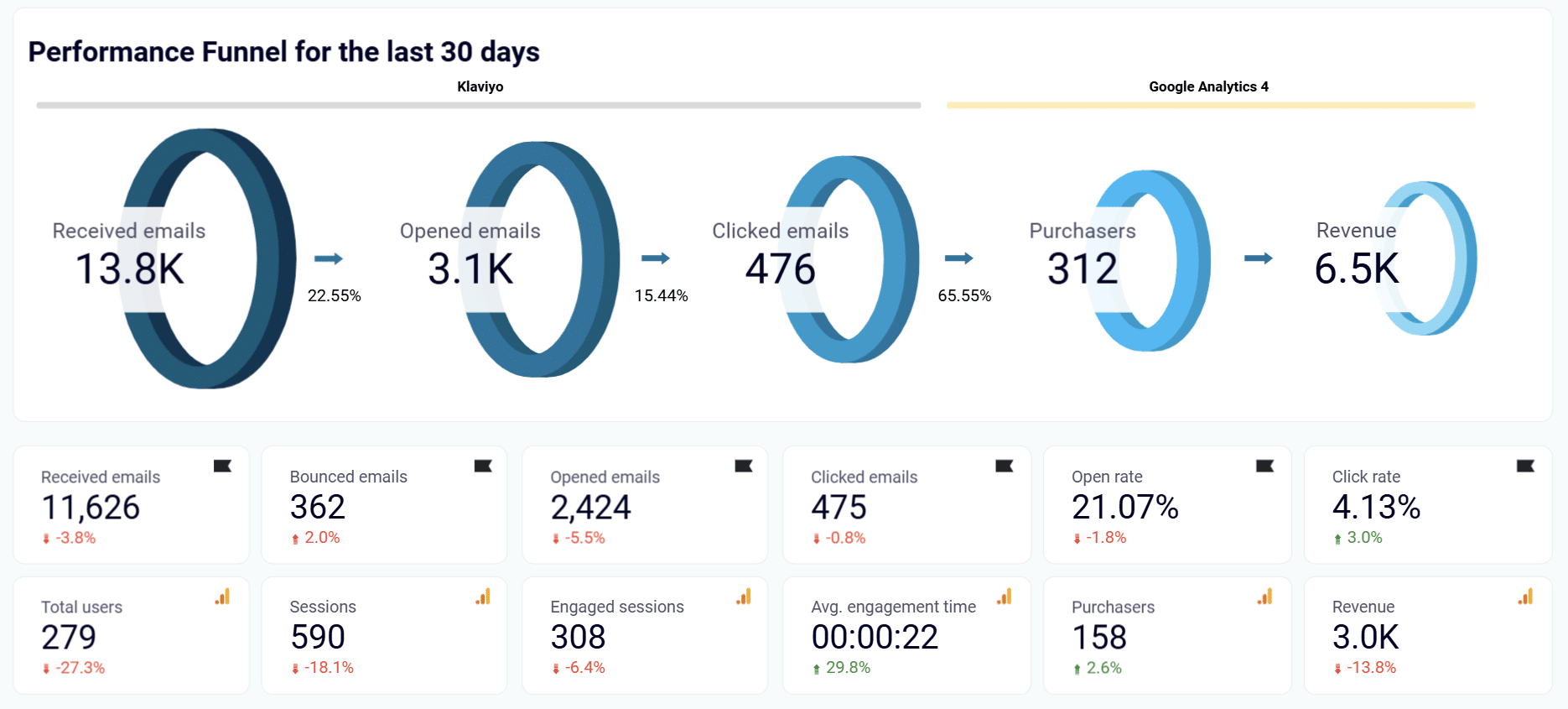
Example of Marketing Funnel Dashboard (Source: Coupler.io)
This is where sales and marketing alignment becomes critical; marketing cannot fix a broken sales process, and sales cannot compensate for poor lead quality.
Revenue Quality and Long-Term Growth Metrics
Revenue alone is not enough.
Some revenue is healthy. Some revenue is expensive. Some revenue creates future growth. Some revenue creates operational pain.
A beginner may celebrate a campaign that drives many first-time purchases.
A more experienced marketer asks:
- Were these customers profitable?
- Did they only buy because of a heavy discount?
- Did they come back?
- Did they refund?
- Did they refer others?
- Did they buy higher-margin products later?
This matters for e-commerce brands in Singapore because the market is compact and competition is intense. If a brand keeps reacquiring one-time discount buyers, it may look like it is growing while quietly weakening profitability.
For Saas And Subscription Businesses, Retention Is Even More Important
A campaign that brings in many customers with high churn is not a growth engine. It is a leaky bucket.
This is where marketing metrics that matter go beyond acquisition. You need to track:
- Repeat purchase rate
- Retention rate
- Churn rate
- Average order value
- Gross margin
- Refund rate
- Customer lifetime value
- LTV:CAC ratio
- CAC payback period
A Practical Example
An online supplement store spends heavily on ads and acquires many first-time buyers through a 40% discount.
The first purchase ROAS looks good. But if customers do not return at full price, the campaign may not create long-term value.
In that situation, the marketing team should not only optimise ads. It should look at product bundling, replenishment reminders, post-purchase email, subscriptions, loyalty offers, and customer education.
Key Takeaway: Revenue quality is where performance marketing meets customer strategy – and where many marketing teams fall short because retention is rarely owned by a single department.
Attribution, Blended Measurement, and Marketing Efficiency
Attribution is useful, but it is not reality. It is a model.
This is one of the most important mindset shifts in modern performance marketing. Attribution tries to answer: which channel deserves credit for the conversion?
The problem is that customers do not behave in clean, trackable lines.
A customer may see your TikTok video, click a Meta ad, search your brand on Google, read reviews, visit your website directly, ask a friend, and convert 5 days later.
Which channel caused the sale? The honest answer is that several touchpoints may have contributed.
That is why platform-level reporting can be dangerous if read in isolation. Meta may claim credit. Google may claim credit. GA4 may show something else. Shopify, HubSpot, your CRM, and your finance report may all show slightly different numbers.
Caution: This does not mean you should ignore attribution. It means you should use it carefully.
Google Analytics 4’s data-driven attribution model assigns fractional credit based on how touchpoints contribute to key event probability, which is more nuanced than giving all credit to the last click.
But even data-driven attribution has limitations. It still depends on available data, consent, tracking configuration, platform coverage, and event quality.
This is why marketers should combine attribution with blended measurement.
Useful blended metrics include total revenue, total marketing spend, MER, blended CAC, overall conversion rate, new customer revenue, returning customer revenue, gross margin, and contribution profit.
This is where marketing ROI metrics become more meaningful.
Instead of asking only, which platform claims the best ROAS, ask: when total marketing spend goes up, does total profitable revenue go up as well?
That question is harder to answer, but it is more commercially honest.
What To Look At Alone, and What To Look At Together
Some metrics are useful on their own. Most are more useful in combination.
Here is a practical guide:
| Metric | Can You Read It Alone? | Better Paired With | Why |
| Impressions | Rarely | Reach, frequency, CTR | Impressions alone only show delivery |
| CTR | Sometimes | Conversion rate, CPC, lead quality | High CTR may still attract poor traffic |
| CPC | Rarely | Conversion rate, CAC | Cheap clicks may not become customers |
| CPL | Rarely | Qualified lead rate, close rate, CAC | Cheap leads can waste sales time |
| ROAS | Sometimes | Margin, LTV, MER | Revenue is not the same as profit |
| CAC | Yes, but carefully | LTV, payback period, gross margin | Acquisition cost must be judged against value |
| LTV | No | CAC, retention, churn | High LTV is only useful if acquisition is sustainable |
| MER | Yes | Channel ROAS, spend mix, margin | Strong blended efficiency still needs channel diagnosis |
The beginner mistake is to optimise one metric without checking the trade-off.
- Reducing CPL may reduce lead quality.
- Increasing ROAS may reduce scale.
- Increasing conversion rate may attract lower-value customers if the offer is too aggressive.
- Increasing traffic may reduce average user quality.
- Increasing discounts may raise revenue while damaging margin.
Good measurement is not about chasing one number. It is about understanding the relationship between numbers.
Choosing the Right Metrics for Your Business Stage
The right metrics depend on where the business is.
A new business should not measure itself the same way as a mature brand. A B2B SaaS company should not use the same dashboard as a fashion ecommerce store. A local service business should not blindly copy a venture-funded startup’s growth dashboard.
The right metrics depend on where the business is, what it sells, and how customers buy.
Early-Stage Business
At this stage, the goal is usually to find what works.
Priority metrics include:
- Conversion rate
- CAC
- Cost per qualified lead
- First purchase ROAS
- Enquiry-to-sale rate
- Customer feedback quality
Do not overcomplicate the dashboard. The business needs to know which audience, offer, channel, and message can produce real customers.
For a new Singapore home-based bakery, tracking impressions and likes may be useful for awareness. But the real question is whether social content and ads produce orders, repeat purchases, and referrals.
Growth-Stage Business
At this stage, the goal is to scale without breaking economics.
Priority metrics include:
CAC, ROAS, MER, LTV, repeat purchase rate, gross margin, and payback period.
Warning: This is where many businesses get into trouble. They scale spend because top-line revenue rises, but they do not notice rising acquisition cost, lower quality customers, weaker retention, or shrinking margins.
For a growing ecommerce brand, the dashboard should separate new customer revenue from returning customer revenue. Otherwise, repeat buyers may hide weak acquisition performance.
Mature Business
At this stage, the goal is efficiency, profitability, and channel balance.
Priority metrics include:
MER, incrementality, contribution margin, customer cohort value, retention, market share indicators, brand search demand, and channel mix efficiency.
Key Insight: A mature brand should not blindly cut every channel with weak last-click ROAS. Some channels create demand. Others capture demand.
For example, paid social, YouTube, influencers, PR, and content may support discovery. Search, marketplaces, direct traffic, email, and retargeting may capture existing demand.
If you only fund the bottom of the funnel, you may enjoy efficient short-term sales while slowly weakening future demand.
B2B or High-Ticket Services
For B2B, professional services, education, renovation, finance, or enterprise SaaS, the sales cycle is usually longer.
Priority metrics include qualified lead rate, sales accepted lead rate, pipeline value, lead-to-opportunity rate, opportunity-to-close rate, CAC, sales cycle length, and revenue by source.
For these businesses, raw lead volume is often a trap.
A campaign with fewer leads but stronger qualification may be far better than a campaign that floods the sales team with weak enquiries.
Common Fallacies and Mistakes Beginners Make
Beginners usually do not fail because they lack data. They fail because they misread the data.
Mistake 1: Treating Platform ROAS as Absolute Truth
Ad platforms report performance from their own view of the world. That does not mean they are lying. It means each platform has its own attribution logic, tracking limitations, conversion windows, and modelling assumptions.
How to avoid this:
- Always compare platform data with GA4, CRM data, ecommerce backend data, and actual revenue.
- Use blended metrics like MER to get a more complete picture
- Don’t make budget decisions based on a single platform’s report
Mistake 2: Optimising for Cheap Leads
Cheap leads often look good in reports. But if the leads are unqualified, they create hidden costs:
- Sales teams waste time.
- Follow-up rates drop.
- Conversion rates fall.
- Team morale suffers from chasing dead ends
How to avoid this:
- Optimise for lead quality, not lead volume
- Track qualified lead rate and close rate alongside CPL
Remember: Sometimes the real problem is simple: the campaign was optimised for form fills, not customers.
Mistake 3: Looking at ROAS Without Margin
ROAS is revenue-based. It does not automatically tell you profit.
Why this matters:
- A product with low gross margin may have strong ROAS but weak profit
- High fulfilment costs can eat into revenue
- Refund rates and heavy discounting reduce actual profitability
How to avoid this:
- Track gross margin alongside ROAS
- Calculate contribution profit, not just revenue
- Understand your true cost of goods sold (COGS)
Mistake 4: Judging Long-Sales-Cycle Campaigns Too Early
If the buying journey takes 60 days, a 7-day report will not tell the full story.
The danger:
- You may pause campaigns that would have produced good customers later
- Early data can make a campaign look expensive before conversions close
- You optimise too aggressively based on incomplete information
How to avoid this:
- Use leading indicators early
- Wait for lagging indicators before making bigger budget decisions
- This is where CRM discipline matters – track leads through the entire sales cycle
Mistake 5: Ignoring Retention
Acquisition gets attention because it is visible. Retention often gets ignored because it sits across multiple departments:
- Product
- Service
- Email marketing
- CRM
- Loyalty programmes
- Customer experience
Why this is costly:
- If customers return, your acquisition cost becomes easier to justify
- High churn means you’re constantly filling a leaky bucket
- Repeat customers are typically more profitable than new ones
How to avoid this:
- Track repeat purchase rate, retention rate, and churn rate
- Invest in post-purchase communication and loyalty programmes
- Align marketing, sales, and customer success teams around retention goals
Mistake 6: Reporting Too Many Metrics to Leadership
Leadership usually does not need 30 metrics. They need a clear, concise view of what matters.
What leadership actually needs:
- Spend (total marketing investment)
- Revenue generated
- CAC (cost to acquire customers)
- ROAS or MER (efficiency metrics)
- Conversion rate
- Lead or customer quality indicators
- Margin impact
Every report should also state what changed since the last report and what action is recommended.
These are report sections, not extra metrics, and they are what turns a dashboard into a decision.
How to avoid this:
- Simplify your dashboard to 5–7 key metrics
- Focus on metrics that drive decisions, not just data that looks interesting
- A good report should lead to a decision
The Bottom Line: The best marketers don’t avoid mistakes because they have more data. They avoid mistakes because they know which metrics to trust, which to question, and how to read them in combination, not isolation.
The Future of Marketing Performance Measurement
Marketing measurement is becoming harder and more advanced at the same time.
It is harder because customer journeys are fragmented, privacy expectations are higher, and platform-reported data does not always show the full picture.
It is more advanced because marketers now have better tools for modelling, forecasting, automation, and first-party data analysis.
There are four major shifts worth paying attention to.
1. First-Party Data Will Matter More
Businesses can no longer rely only on platform pixels and third-party tracking.
They need cleaner first-party data from website events, CRM systems, ecommerce platforms, email platforms, offline sales teams, customer databases, call tracking, payment systems, and revenue systems.
Google’s enhanced conversions are designed to improve conversion measurement by using observable first-party data collected through the Google tag, while supporting more privacy-conscious measurement.
In Singapore, this must be built on PDPA-compliant consent.
If you plan to use customer lists for CRM remarketing, lookalike audiences, or enhanced conversions, make sure your data collection notices and consent actually cover those uses.
Clean first-party data that was collected without proper consent is a liability, not an asset.
For Singapore businesses, the practical point is simple. Your ad account cannot do all the work if your website, CRM, and sales data are messy.
2. Attribution Will Be Supported by Incrementality Testing
Attribution tells you what gets credit.
Incrementality asks a better question: what happened because of the marketing activity that would not have happened otherwise?
Google has been making incrementality testing more accessible through lower spend thresholds and improved methodology across campaign types, according to its Ads and Commerce product updates.
This is important because a campaign may appear to drive conversions that would have happened anyway.
For example, branded search often looks highly efficient. But some users searching for your brand may already have decided to buy.
Incrementality testing helps separate captured demand from created demand.
3. Marketing Mix Modelling Will Become More Practical
Marketing Mix Modelling, or MMM, used to feel like something only large companies could afford.
That is changing.
Google released Meridian as an open-source Marketing Mix Model built for modern consumer journeys and cross-channel measurement. Google’s developer documentation describes Meridian as an open-source MMM designed to support privacy-durable advanced measurement.
This does not mean every SME needs to run MMM tomorrow. But the direction is clear.
Measurement is moving beyond platform screenshots and towards more blended, modelled, and business-level analysis.
4. AI Will Help Analyse Performance, but It Will Not Fix Bad Thinking
AI can help marketers summarise reports, detect anomalies, forecast outcomes, generate insights, and speed up analysis.
Google’s Think with Google has discussed how AI-powered measurement can improve data management, insights, decisions, and results for marketers.
But AI does not automatically know which metric matters most to your business.
If your tracking is messy, AI will analyse messy data. If your goals are vague, AI will optimise towards vague outcomes. If your team rewards cheap leads, AI will help you get more cheap leads.
The future of measurement is not just AI. It is better data discipline, better business questions, and better judgment.
Singapore Context
This is also relevant in Singapore because digital adoption is no longer limited to technology companies. IMDA’s Singapore Digital Economy Report 2025 states that more than two-thirds of Singapore’s digital economy came from digitalisation in non-Information & Communications sectors.
That means better marketing measurement is increasingly relevant to mainstream sectors, including retail, education, healthcare, finance, logistics, F&B, and professional services.
A Practical Metric Guide by Business Type
Here is a simpler way to decide what to focus on.
| Business Type | Primary Metrics | Secondary Metrics | Watch Out For |
| New e-commerce brand | Conversion rate, CAC, ROAS | AOV, add-to-cart rate, checkout rate | Mistaking discount-driven sales for real demand |
| Mature ecommerce brand | MER, LTV, repeat purchase rate | ROAS, margin, refund rate | Scaling revenue while shrinking profit |
| Local service business | Cost per qualified lead, close rate, CAC | CPL, enquiry volume, response time | Optimising for cheap enquiries |
| B2B lead generation | Pipeline value, qualified lead rate, CAC | CPL, CTR, landing page conversion rate | Counting leads before checking sales quality |
| SaaS or subscription | CAC, LTV, churn, CAC payback | Trial-to-paid rate, retention, activation | Acquiring customers who leave too quickly |
| Education or training | Enrolment rate, CAC against nett fees, qualified lead rate | CPL, course page conversion rate | Treating enquiries as enrolments; ignoring funding-cycle lag |
| Retail or omnichannel | MER, store sales lift, online revenue, repeat purchase | ROAS, footfall, email revenue | Under-counting offline influence |
Conclusion: Stop Reporting Everything
The best marketing dashboard is not the biggest one. It is the one that helps the business make better decisions.
Vanity metrics can show visibility. Leading metrics can diagnose problems. Lagging metrics can prove commercial impact.
But none of these metrics should live in isolation.
Here’s a quick recap:
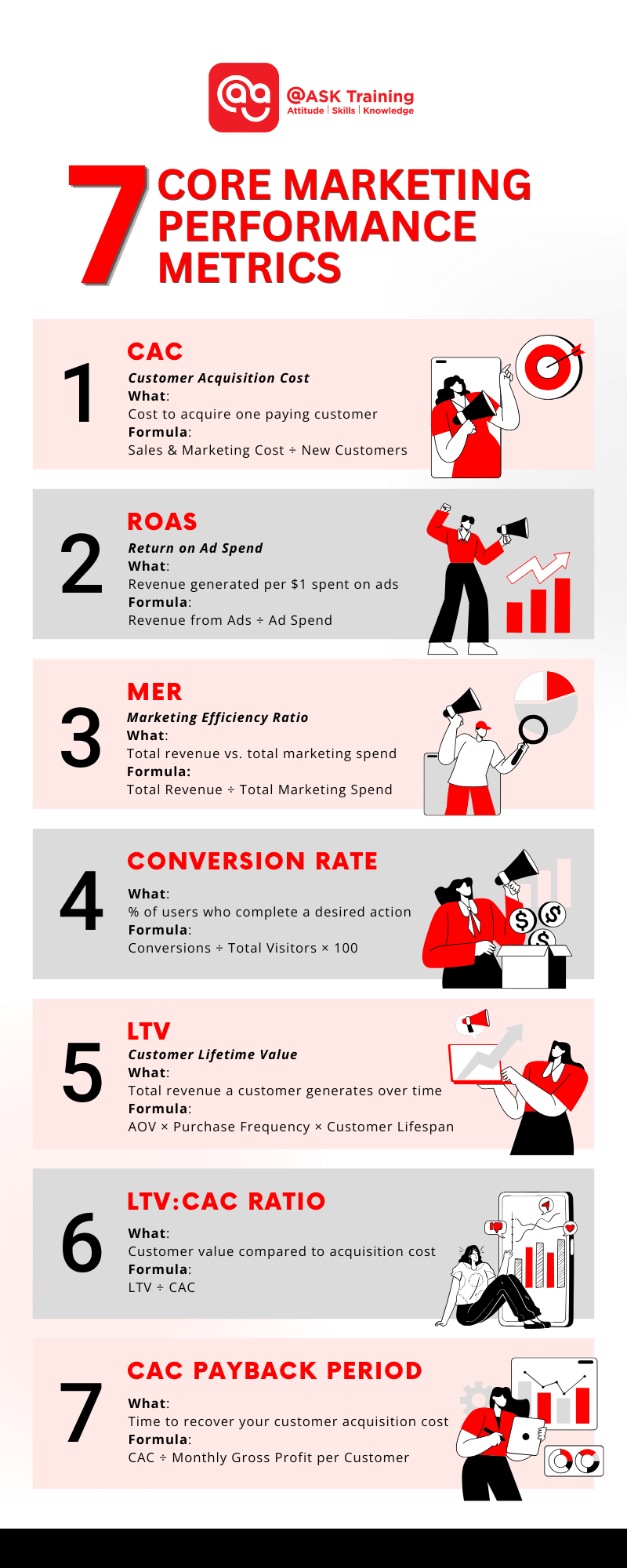
CTR means little without conversion rate. CPL means little without lead quality. ROAS means little without margin. CAC means little without LTV. Revenue means little without profitability.
- For early-stage businesses: Focus on finding working channels, offers, audiences, and conversion points.
- For growth-stage businesses: Focus on CAC, ROAS, MER, LTV, and payback.
- For mature businesses: Focus on efficiency, incrementality, retention, margin, and channel balance.
- For B2B or high-ticket businesses: Focus less on raw lead volume and more on qualified pipeline, close rate, sales cycle length, and revenue by source.
The beginner mistake is to report what is easy to measure. The better approach is to report what helps the business act.
That is the real purpose of performance measurement. Not to prove that marketing was busy. To prove that marketing helped the business grow.
Understanding marketing performance metrics is one thing. Mastering the tools to track, analyse, and optimise them is what sets top marketers apart.
Ready to Master Performance Marketing Analytics?
At @ASK Training, our range of Digital Marketing courses equips you with practical, hands-on skills using tools like Google Analytics 4. Learn from industry veterans and earn a certification that validates your expertise.
Explore our Digital Analytics courses:
- (24hrs) Digital Marketing Analytics (Google Analytics) – Master Google Analytics 4 to measure campaigns, identify key tools, and forecast demand.
- (16hrs) Digital Advertising – Learn to craft a well-rounded digital advertising strategy from start to finish, while tracking your performance to make cost-effective decisions.
- (24hrs) Website and Landing Page Conversion Optimisation – Learn consumer psychology and design techniques to boost engagement and conversions.
Enrol with us! Start measuring what matters and build the skills to prove it.
Related Courses
◆◆◆
Related Articles
Article Topics
- Why Reports Fail
- Vanity, Leading & Lagging Metrics
- Lagging Metrics
- Core Revenue Metrics
- Acquisition & Cost Efficiency
- Conversion & Funnel Metrics
- Revenue Quality
- Attribution & Marketing Efficiency
- Business Stage Metrics
- Common Metric Mistakes
- Future of Measurement
- Metric Guide by Business Type
- Conclusion
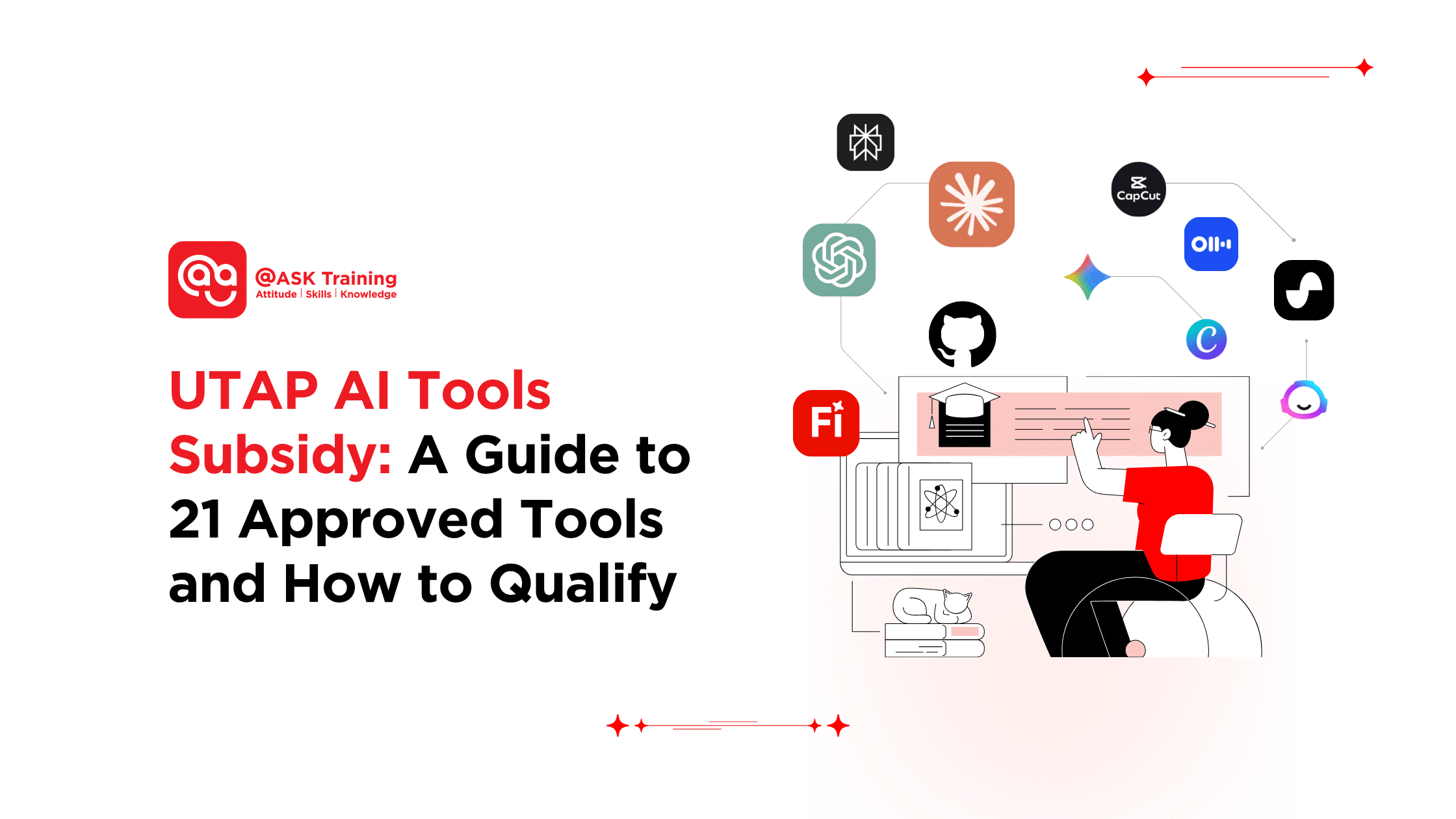
Staying ahead in today’s workplace means more than just having the right skills, it’s about having access to the right tools. But keeping up with the latest AI software can get expensive.
Here’s some great news for NTUC members: from May 2026, the Union Training Assistance Programme (UTAP) has expanded its support to cover 50% of your AI tool subscription fees. This means you can access powerful AI tools like ChatGPT, Claude, and Midjourney at half the cost.
Let’s break down how the UTAP AI Tools Subsidy works, how much you can save, and a detailed look at the 21 tools you can claim.
How the NTUC AI Tools Subsidy Works
Before you start planning your subscriptions, it’s essential to understand the requirements. The UTAP AI tools subsidy is a reimbursement scheme, not an upfront discount.
Here’s how it works:
Who is Eligible?
- Active NTUC Union Members: Your membership must be valid from the time you enrol in a course through to when you submit your claim.
- Complete a UTAP-Approved AI Course: You must complete a UTAP-approved AI course first. You’ll need to attend at least 75% of the course.
- Course Completion Within One Year: The AI course must be completed before your AI tool subscription starts, and within one year of the subscription date.
- Subscribe Within the Window: Your subscription start date must fall between 1 May 2026 and 30 April 2028.
- Personal Use Only: The subscription must be for your own personal use, not a shared or business account.
- Claim Within 6 Months: You must submit your UTAP claim within 6 months of the subscription start date.
Good to know: The AI tool you subscribe to does not need to be related to the AI course you took. Any UTAP-approved AI course unlocks any UTAP-approved AI tool.
How Much Can You Claim?
You can claim 50% back on your subscription fees, but it’s subject to an annual cap. This cap is shared with any UTAP course fee claims you make in the same calendar year.
| Member Age | Annual UTAP Cap | Subsidy Rate |
| Below 40 | $250 per calendar year | 50% of subscription cost |
| 40 and above | $500 per calendar year | 50% of subscription cost |
How UTAP calculates your claim:
The claim is based on the net amount you paid after all other subsidies. For example, if you paid $368 out-of-pocket for a course after WSDA subsidy and SkillsFuture Credit, UTAP reimburses 50% of that amount ($184).
Example: How a 45-Year-Old Member Utilises UTAP
| Component | Details | Amount (Illustrative) |
| AI Course (UTAP-Approved) | AI in HR course (full fee, incl. GST) | S$1,362.50 |
| Less: Government subsidy (up to ~90%) | – S$1,125.00 | |
| Less: SkillsFuture Credit (example only) | – S$100.00 | |
| Net out-of-pocket course fee | S$137.50 | |
| UTAP claim on course fee (50% of S$137.50) | S$68.75 | |
| AI Tool Subscription | ChatGPT Plus (12-month estimate) | S$324.00 |
| UTAP claim on AI tool (50% of S$324.00) | S$162.00 | |
| Total UTAP Claim for the Year | Course + AI tool (within S$500 cap for age 40+) | S$230.75 |
Note: Figures are illustrative. Actual fees, subsidy levels, and SkillsFuture Credit usage depend on current funding rules and individual eligibility.
Key Takeaway: The AI tool subsidy is only available if you complete a UTAP-approved AI course first. The course and the tool do not need to be related; any approved AI course unlocks any approved AI tool.
How Much Will You Save? A Price Breakdown
The savings can be significant. Let’s look at the annual cost (approximately) for some of the most popular AI tools and how much you could get back.
| AI Tool | Approx. Annual Cost (SGD) | UTAP 50% Subsidy (SGD) | Your Net Cost (SGD) |
| ChatGPT Plus | ~$324 | ~$162 | ~$162 |
| Claude Pro | ~$324 | ~$162 | ~$162 |
| GitHub Copilot Individual | ~$162 | ~$81 | ~$81 |
| Canva Pro | ~$180 | ~$90 | ~$90 |
| Perplexity Pro | ~$324 | ~$162 | ~$162 |
Note: Prices are estimates based on USD rates and may vary. When claiming, convert the amount to SGD and upload your bank or card statement as proof of payment.
The Full List of 21 UTAP-Approved AI Tools
Here’s the complete breakdown of all 21 AI tools eligible for the UTAP subsidy, including what they do and who they’re best for.
AI Assistants for General Work
1. ChatGPT
- The most widely used AI assistant, perfect for writing, summarising, brainstorming, coding, and research.
- Best for: General AI assistance across any role.
2. Claude
- Excels at analysing long documents, structured writing, and nuanced reasoning.
- Best for: Professionals working with lengthy reports or complex writing.
3. Google AI (Gemini)
- Integrated with Google Workspace (Gmail, Docs, Sheets), making it a seamless addition for users in that ecosystem.
- Best for: Professionals who rely heavily on Google services.
4. Perplexity
- An AI-powered research and answer engine that provides real-time search with citations.
- Best for: Researchers, analysts, and students.
5. Kimi
- Designed to handle extremely long documents (up to 200,000 words) in a single session.
- Best for: Analysts, researchers, and legal professionals.
Coding & Development
6. GitHub Copilot
- An AI coding assistant that lives in your code editor (like VS Code), suggesting completions and writing code from comments.
- Best for: Developers and anyone learning to code.
7. Blackbox AI
- A multi-model coding platform that generates, debugs, and optimises code across 80+ programming languages.
- Best for: Developers needing advanced coding assistance.
8. Replit
- A browser-based coding platform with AI agents for building, testing, and deploying applications directly from the cloud.
- Best for: Developers, students, and founders.
Content, Design & Creativity
9. Canva
- A popular design tool with built-in AI for image generation, background removal, and presentation creation.
- Best for: Non-designers needing quick visuals.
10. Midjourney
- A powerhouse for creating highly detailed, artistic, and cinematic AI imagery.
- Best for: Designers, artists, and marketers.
11. Adobe Firefly
- Adobe’s AI image generation tool, trained on licensed content and integrated with Photoshop and Illustrator.
- Best for: Creative professionals needing commercially safe visuals.
12. Leonardo.Ai
- An image generation platform offering fine-tuned control over different art styles.
- Best for: Game designers, illustrators, and creative pros.
13. Suno
- Generates original songs and audio from text prompts.
- Best for: Content creators and marketers needing royalty-free music.
14. CapCut
- A popular video editing tool with AI features like auto-captions, background removal, and text-to-video.
- Best for: Social media managers and content creators.
15. ElevenLabs
- A realistic voice generation platform for creating professional-grade voiceovers without a recording studio.
- Best for: Content creators, educators, and businesses.
16. Jasper AI
- An AI content platform for marketing teams, generating long-form writing, campaigns, and social posts with brand voice controls.
- Best for: Marketing teams and content managers.
17. Copy.ai
- An AI copywriting tool for generating ad copy, email sequences, and product descriptions.
- Best for: Marketing teams and copywriters.
Productivity, Automation & Research
18. Notion AI
- Brings AI directly into the Notion workspace for generating notes, summarising content, and organising projects.
- Best for: Professionals and students managing knowledge.
19. Otter AI
- An AI meeting assistant that transcribes, summarises, and organises meetings from Zoom, Teams, and Google Meet.
- Best for: Sales teams, professionals, and students.
20. Manus
- An AI agent platform for deep research, workflow execution, and large-scale task automation.
- Best for: Professionals managing research-heavy tasks.
21. Studley AI
- An AI study assistant designed to help students solve questions, create flashcards, and revise.
- Best for: Students and lifelong learners.
Want to suggest a tool? NTUC members can propose new AI tools for consideration via the UTAP portal. Submissions are reviewed quarterly, so the list may grow over time.
Be sure to visit NTUC’s Official Portal for the full AI tool list and courses.
Why @ASK Training is Your Ideal Partner
At @ASK Training, our philosophy is simple: “People First, Learning Always.” We believe that technology should serve people, not the other way around.
That’s why we don’t just teach AI tools. We help you use them to do your job better, so you can focus on what matters most: your work, your team, and your growth.
1. Up to 90% SkillsFuture Funding
Quality AI training shouldn’t be out of reach. Our Generative AI courses are eligible for up to 90% SkillsFuture funding, making professional upskilling significantly more affordable.
SkillsFuture Credits can also be used on top of existing subsidies for Singapore Citizens aged 25 and above.
2. Cross-Domain AI Courses for Your Specific Role
Most AI courses teach you about AI in general. We take a different approach. Our courses are built around specific job functions, whether you’re in HR, Finance, Marketing, Operations, or Business Intelligence.
This cross-domain focus means you learn AI in the context of your actual work, not generic theory.
@ASK Generative AI Courses
| Course | Who It’s For |
| AI-Driven Sales & Marketing | Marketers, sales professionals, business owners |
| AI in HR | HR professionals, managers, SME owners |
| AI-Powered Finance | Finance professionals, business owners |
| AI in Business Intelligence | Business owners, managers, BI analysts |
| AI in Operations | Operations managers, process improvement leads |
| AI Smart Inventory | Operations, supply chain, logistics professionals |
Important Note: As subsidy details and course listings are updated periodically, we strongly recommend contacting our programme consultants to confirm the latest eligibility and funding details before enrolling. They can also advise on the best course for your role and guide you through the claim process.
3. Practical Learning for Real-World Application
Our courses are designed to be hands-on and practical. You’ll work with tools like ChatGPT, Claude, Microsoft Copilot, and DeepSeek on tasks relevant to your role. The goal is to help you apply what you learn directly to your work.
4. Trusted and Accessible
@ASK Training has been a trusted Skills and Workforce Development Agency (SWDA) Approved Training Organisation since 2014.
Our courses are eligible for up to 90% SWDA subsidy, and many are UTAP-claimable, making quality AI training more accessible.
What this means for you: With UTAP and SWDA subsidies combined, course fees can be significantly reduced and also unlock the 50% AI tool subscription subsidy.
Wrapping Up: Understanding UTAP’s AI Tools Subsidy
The UTAP expansion is part of Singapore’s broader efforts to support workforce development in the AI space. For NTUC members, this means there’s now additional support available when you invest in AI upskilling.
Here’s the key point: the AI tool subsidy is tied to course completion. You can’t claim it on its own.
The sequence:
- Complete a UTAP-approved AI course with at least 75% attendance
- Subscribe to any of the 21 approved AI tools within one year
- Claim 50% back on subscription fees, subject to the annual UTAP cap
The programme runs until 30 April 2028. The annual cap resets each calendar year, so starting earlier gives you more flexibility.
The real value lies not in the subsidy itself, but in the skills you gain. AI tools are most effective when you understand how to use them well, and that understanding comes from quality training relevant to your role.
Start Your AI Journey with @ASK Training
The UTAP AI tools subsidy is a valuable opportunity to make AI tools more accessible. But navigating the details, eligibility, course selection, and the claim process can feel overwhelming.
That’s where we come in.
How we help:
- Clarify which courses are UTAP-eligible and guide you through the claim process
- Match you with the right course based on your role and goals
- Provide hands-on, practical training you can apply immediately
We’re here to help you take that first step, at your own pace, with guidance you can trust.
Ready to explore? Browse our Generative AI courses or speak to our programme consultants for personalised guidance.
Frequently Asked Questions
Q1: What is the UTAP AI Tools Subsidy?
The UTAP AI Tools Subsidy is an expansion of the Union Training Assistance Programme that took effect in May 2026. It allows NTUC members to claim 50% back on subscriptions to approved AI tools like ChatGPT, Claude, and Midjourney.
To unlock it, members must first complete a UTAP-approved AI course. The subsidy runs until 30 April 2028.
Q2: Which AI tools does NTUC subsidise?
NTUC subsidises 21 approved AI tools under the expanded UTAP programme, including ChatGPT, Claude, GitHub Copilot, Midjourney, Notion AI, Canva, and more. The full list is available on the NTUC website and is reviewed regularly.
Q3: Do I need to complete a course before claiming the AI tool subsidy?
Yes. You must complete a UTAP-approved AI course with at least 75% attendance before subscribing to an eligible AI tool. The AI course end date must be within one year of your subscription start date.
Q4: Which courses at @ASK Training are UTAP-claimable?
All our Generative AI courses are UTAP-claimable. This includes:
- AI-Driven Sales & Marketing
- AI in HR
- AI-Powered Finance
- AI in Business Intelligence
- AI in Operations
- AI Smart Inventory
Please note: For the latest updates on eligibility, we recommend contacting our programme consultants.
Q5: Can I claim for more than one AI tool?
Yes. Members may claim subscription fees for more than one AI tool, subject to the maximum reimbursement cap.
The total claimed across all tools and courses in a calendar year cannot exceed your annual UTAP cap ($250 for under 40, $500 for 40 and above).
Related Courses
◆◆◆
Related Articles
The way Singaporeans work has changed. Tools like ChatGPT, Copilot, and Gemini have moved from “nice-to-have” novelties to essential daily drivers for productivity.
By 2026, knowing how to talk to AI is a core business competency:
- Marketing teams use it to draft campaigns.
- HR professionals rely on it to streamline recruitment.
- Finance and operations staff automate reporting and data analysis.
Across every department, employers expect AI fluency.
However, the market is now flooded with training options. Finding the right Gen AI course in Singapore can feel overwhelming. Should you sign up for a university-backed certificate or a fast-paced hands-on workshop?
This guide reviews the leading providers offering Gen AI training in Singapore. We focus on relevance, structure, and real-world learning outcomes.
Our goal is simple: help you pick the training that actually moves the needle for your work.
Let’s get started.
How to Choose the Right Gen AI Training Provider in Singapore
Before you book a seat, you need a game plan. Not all courses are created equal. Some focus on theory, while others focus on getting the job done.
Here’s how to filter your options for a generative AI course in Singapore:
1. Prioritise Practical Skills
Look for courses that teach prompt structuring and workflow integration, not just “what ChatGPT is.”
You want to learn how to build AI agents or automate reports.
2. Map Training to Tasks
Does the course teach you to write emails, analyse data, or code? Ensure the syllabus aligns with your daily work.
3. Short Workshop vs. Structured Programme
Short workshops are great for a quick overview. However, structured Gen AI courses offer deeper dives into strategy and ethics.
4. Real-World Applications
Avoid providers that only lecture. You need a course that allows you to use the tools in real-time scenarios.
Example:
Choosing a provider that teaches you how to structure a prompt for a specific business outcome is infinitely more valuable than one that only shows you the features of the chatbot.
Now that you know what to look for, let us examine the leading providers in Singapore and how they stack up against these criteria.
Leading Gen AI Training Providers in Singapore
We have analysed the market for 2026. From academic institutions to hands-on training centres, these providers offer the most relevant AI training courses in Singapore for professionals today.
1. @ASK Training
Best for: Cross-domain relevance across multiple departments
@ASK Training offers one of the wider spreads of Generative AI options for both individuals and corporate teams. They focus on making AI useful for specific business functions.
- Why choose them: They cover HR, Business Intelligence, Finance, and Digital Marketing. If you want a provider that understands that AI impacts accounting differently than it impacts social media, this is a strong choice.
- The Focus: Practical application for workplace productivity.
- Verdict: A strong option for those looking for cross-domain AI application knowledge and business-relevant coverage tailored to specific job roles.
2. SMU Academy
Best for: Strategic leadership and academic structure.
SMU Academy provides Generative AI programmes within a structured academic framework. They have recently launched advanced programmes aimed at creating “AI Bilingualists”, leaders who can translate business goals into technical solutions.
- Why choose them: They focus on organisational change and governance. Their modules often include ethics, compliance, and Large Language Models (LLMs) for business.
- The Focus: Strategic understanding and business transformation.
- Verdict: Ideal for managers and executives looking to lead AI adoption across an enterprise.
If SMU Academy leans towards strategy, what about providers that focus on deep technical skills?
Let us look at Heicoders next.
3. Heicoders Academy
Best for: High-intensity, technical upskilling.
Rated highly by tech professionals, Heicoders focuses on turning learners into job-ready AI practitioners. Their Generative AI course offerings cover everything from foundational Python to advanced AI agents.
- Why choose them: They have corporate partnerships and a focus on “Agentic AI”, where AI performs complex tasks autonomously.
- The Focus: Technical depth and autonomous workflows.
- Verdict: A strong fit for those wanting to move beyond basic prompting into building AI tools.
Beyond the institutes mentioned, other established players also offer unique strengths depending on your industry and learning style.
4. Aventis Learning Group
Best for: Working professionals needing flexibility.
Aventis offers a range of Generative AI training designed for flexibility. They focus on short-form training that applies AI concepts across different business functions like strategy and management.
- Why choose them: Their formats are accessible and designed for the busy executive.
- The Focus: Strategic application across business functions.
- Verdict: Good for a high-level overview without a massive time commitment.
5. OOm Institute
Best for: Marketing and content creation.
OOm Institute dives deep into the intersection of digital marketing and AI. If you work in SEO, social media, or content strategy, their Gen AI courses Singapore are tailored for you.
- Why choose them: They focus on practical applications of tools like ChatGPT for ad copy, SEO, and data analysis.
- The Focus: Hands-on marketing use cases.
- Verdict: Perfect for digital marketing teams and content creators.
6. Info-Tech Academy
Best for: Beginners and general workplace productivity.
Info-Tech Academy provides foundational training for those new to the AI landscape. They focus on helping beginners understand the landscape and apply basic tools to their daily work.
- Why choose them: Their courses are accessible and designed for those with zero experience.
- The Focus: Foundational understanding and general application.
- Verdict: A solid starting point for individuals or teams just beginning their AI journey.
7. James Cook Institute
Best for: Structured business professional training.
James Cook Institute offers Generative AI training focused on structured workplace usage. They provide a generalist approach, helping business professionals understand how Gen AI fits into their existing roles.
- Why choose them: Structured delivery for corporate environments.
- The Focus: General workplace integration.
- Verdict: A reliable option for exploring how AI fits into standard business operations.
With so many options ranging from technical bootcamps to marketing-focused programmes, how do you decide which one fits your career best?
Let us bring it all together.
Final Thoughts: Choosing the Right Gen AI Training Provider for 2026
The “best” provider depends entirely on your goal.
If you want to govern AI strategy at a large firm, look towards SMU Academy. If you want to build AI apps, Heicoders is your answer. If you need to write better reports and automate marketing tomorrow, OOm Institute is an excellent fit.
@ASK Training remains a versatile powerhouse for those looking for cross-domain, business-relevant coverage that speaks to HR, finance, and marketing teams simultaneously.
Here’s a quick recap:
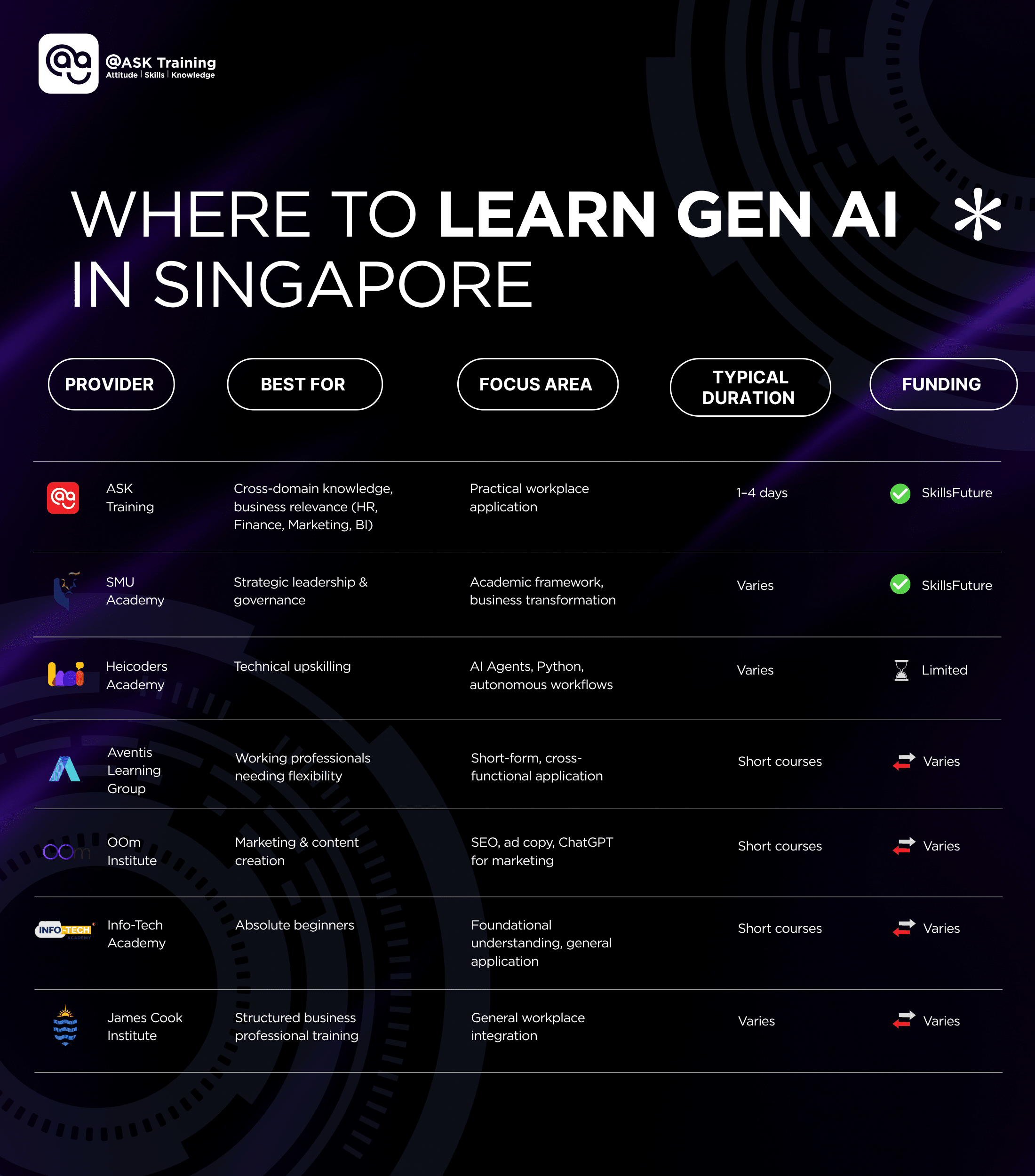
Do not just look at the training labels. Look at the outcomes. Does the provider teach you to integrate AI into your specific workflow?
As we move through 2026, the professionals who thrive will not be the ones who can describe AI, but the ones who can use it to solve problems.
Ready to Explore Generative AI?
You have seen how different providers stack up. Now, see where practical, role-specific training meets real-world business needs.
At @ASK Training, we offer a range of Generative AI courses in Singapore designed for HR, finance, marketing, business intelligence, and workplace productivity.
Recommended WSQ-Certified Courses
If you are looking for structured, SkillsFuture-funded training, these courses are a great place to start:
- WSQ AI in HR (3 Days): Streamline recruitment, forecast workforce needs, and build fairer, data-driven HR strategies.
- WSQ AI-Powered Finance (3 Days): Automate reporting, detect fraud, and stay compliant with responsible AI practices.
- WSQ AI-Driven Business Intelligence (3 Days): Turn raw data into executive-ready insights with Active BI systems and AI-driven dashboards.
Beyond WSQ courses, we also offer shorter courses like Beyond ChatGPT: The Ultimate GenAI Toolkit for Workplace Productivity (1 Day) for those seeking a fast, practical introduction to multiple AI tools.
All courses are taught by industry veterans. Funding options are available for eligible learners.
Feel free to contact our course consultant to find out what suits you best. Your next career advantage in AI is just one course away!
If you run a business, agency, or consultancy, you have likely heard the panic by now. “SEO is dead.” “Google’s AI is taking our traffic.” “Nobody clicks links anymore.”
Take a deep breath. The truth is far less dramatic and far more actionable.
Google’s AI-powered search experiences, including AI Overviews and conversational search modes, are changing how people discover information and how often they click through to websites. But they are not killing SEO. They are raising the standard.
Here is what is actually happening: Google AI search is not the death of SEO. It is the enforcement of better SEO. The businesses losing ground right now are not victims of an algorithm change. They are victims of their own vague messaging.
This article explains what has changed, what has not changed, and, most importantly, what you need to fix first.
First, let’s take a look at their recent announcements and what businesses need to know.
Google I/O 2026: What You Need to Know
At Google’s annual I/O conference (May 19, 2026), the company unveiled sweeping changes to AI Search. Here are the key announcements that affect your business:
1. AI Mode: 1B+ Monthly Users
What it means for you: Your customers are already using AI search. If your website is vague, they will never see you.
2. Gemini 3.5 Flash as Default
What it means for you: Google is making AI search faster and smarter. Generic content will be filtered out more aggressively.
3. Intelligent Search Box
What it means for you: Users can now search with images, files, and videos. Your content must be optimised for multiple formats, not just text.
4. Search Agents (24/7)
What it means for you: AI agents scan the web continuously for users. Your brand needs to be cited consistently across blogs, news, social, and reviews or agents will never surface you.
5. Generative UI
What it means for you: Search now builds custom visuals, tables, and dashboards from your content. If your information is not structured and citable, you will be excluded from these rich answers.
6. Personal Intelligence
What it means for you: Search connects to Gmail, Photos, and Calendar. Your brand may be recommended based on a user’s personal data. Inconsistent external signals will hurt you.
Read more at: Google Official Blog
The bottom line? Clarity, specificity, and credibility are no longer optional. They are survival requirements.
These updates might feel sudden, but the truth is, Google has been heading in this direction for a long time. Let us look at how we got here.
Google Has Been Moving Toward This for Years
Let us rewind for a moment. Before AI Overviews, before AI Mode, Google spent over a decade telling website owners the same thing: create useful content, answer real search intent, demonstrate trust, and make your pages easy to crawl.
Google’s own SEO Starter Guide still emphasises clear writing, useful structure, and crawlable, indexable content. Major updates like:
- Hummingbird (semantic search)
- RankBrain (machine learning for intent)
- BERT and MUM (natural language understanding)
They all point to the same goal: understanding meaning, not just keywords.
Google AI search did not appear out of nowhere. It is the logical next stage of the same mission: rewarding clarity, usefulness, and credibility.
The only difference now is that the test is harder. Generic, low-effort content that used to rank simply because it contained the right keywords is no longer good enough.
Google’s AI can now read, summarise, and compare information across dozens of sources in seconds. If your website is vague, the AI will simply ignore it and cite someone clearer.
So if Google has been heading in this direction for years, what actually changes when search becomes AI-led? Let us break it down.
What Actually Changes When Search Becomes AI-Led
To understand why vague websites struggle, you first need to understand how the game has changed.
Traditional search returns a list of blue links. AI Mode Google and AI Overviews do something very different.
They generate answers. They summarise information, interpret context, compare options, and pull from multiple sources to give the user a complete response without leaving the search page.
This changes where your business needs to appear:
- Ranking number one is no longer the only goal.
- You now need to be understood, cited, or recommended inside the AI-generated answer.
- Visibility increasingly depends on being included in the answer itself, not just ranking for it.
Industry coverage from Search Engine Land and NPR has shown that AI Overviews can reduce click-through rates to traditional results.
This shift in visibility explains exactly why vague, generic websites are losing ground fast.
Why Vague Websites Struggle in AI Search
Here is the hard truth that many business owners do not want to hear: broad, generic positioning does not work in AI-driven search.
Why? Because generative AI search systems match specific user questions against specific information.
Vague positioning fails because it lacks what SEO professionals call “retrievable meaning.”
Compare these two approaches:
Weak Positioning: “We help businesses grow”
- The AI has almost nothing concrete to hold onto.
- What does “grow” mean? More revenue? More customers? Better retention? Lower costs?
- Cannot be reliably matched to specific user queries
Strong Positioning: “We help B2B SaaS companies improve demo-to-customer conversion through landing page testing and lifecycle email sequencing.”
- Audience: B2B SaaS companies
- Problem: Low demo-to-customer conversion
- Method: Landing page testing + lifecycle email sequencing
- Outcome: Improved conversion rates
Which one is easier for an AI to match against a query like “how to improve demo conversion for B2B SaaS”? The second one, every time.
AI search visibility depends on specificity.
The more clearly you state:
- Who you help
- What problem do you solve
- What outcome do you deliver
…the easier it becomes for AI systems to find, trust, and cite you.
So how do you actually get clearer? It starts with fixing your positioning first.
Better SEO Starts with Clearer Positioning
Here is a shift in thinking that will save you years of frustration: positioning is not just a branding problem anymore. It is a search problem.
What You Need to Know
- Entity SEO, the practice of helping search engines understand who you are, what you do, and who you serve, requires clear, consistent, repeated signals.
- This aligns directly with Google’s E-E-A-T framework (Experience, Expertise, Authoritativeness, Trustworthiness).
- Your homepage, your service pages, your about page, your LinkedIn company profile, your Google Business Profile, and even your customer reviews all need to tell the same specific story.
Do not hide your specialisation. Shout it.
For Singapore businesses, adding local qualifiers significantly improves relevance signals:
- “Singapore GST compliance” or
- “B2B SaaS in Southeast Asia”
If you are an accountant, do not say “we help with taxes.” Say “we help e-commerce sellers in Singapore file GST and optimise tax deductions for cross-border sales.”
That level of specificity does not limit your audience. It signals to both humans and AI exactly who you are for.
Once your positioning is sharp, the next question is: what kind of content actually wins in AI search?
Helpful Content Still Matters, But It Needs to Be More Specific
Some marketers have misinterpreted “helpful content” as simply writing long, detailed articles. That was never quite right, and it is definitely wrong now.
SEO for AI search demands content that answers real, specific questions; not just keyword-stuffed generalities.
Stop writing about “digital marketing strategies.” Start writing about:
- “How to reduce paid ad spend without losing leads for home renovation companies”
- “What to do when your Shopify store has traffic but zero sales”
- “Best accounting software for freelancers with multiple income streams in Singapore”
Notice the difference? These titles address specific situations, objections, and outcomes. They sound like something a real person would type or ask an AI assistant.
That is answer engine optimisation in action. Structure your content around the actual questions your customers ask during their decision-making process.
Use clear headers, bullet points, and short paragraphs so AI systems can easily extract and cite your answers.
But even the best content is useless if Google’s AI cannot access your website. That is where technical SEO comes back in.
Technical SEO Still Matters Because AI Search Needs Access
Before you get carried away with positioning and content strategy, do not forget the basics.
If Google cannot access your website, nothing else matters.
Google search AI still relies on crawlability, indexing, site structure, page speed, internal linking, and structured data.
Google’s structured data documentation states that valid structured data can make pages eligible for enhanced search features.
The good news is that the technical bar has not risen dramatically. Clean, fast, well-structured websites that follow basic SEO best practices are still perfectly fine.
The issue is that vague positioning often sits on top of neglected technical foundations, and that combination is deadly.
However, technical access and clear content are still not enough. AI also needs proof that you are trustworthy.
Proof is Becoming Harder to Ignore
Here is something most SEO guides miss: brand visibility in AI search depends heavily on what other people say about you, not just what you say about yourself.
AI systems draw confidence from consensus. If multiple trusted sources describe your business the same way, the AI is far more likely to adopt that description as fact.
This means your proof matters more than ever.
- Collect specific reviews
- Publish detailed case studies
- Get mentioned in industry publications, directories, partner pages, and even forums like Reddit and LinkedIn.
A review that says “great service” is fine. A review that says “we tried three agencies before finding X. They reduced our cost per lead by 40% within 60 days” is gold.
That specific, measurable outcome is exactly what AI systems look for when deciding which sources to trust
But even great proof loses power if your brand story is inconsistent across the web. Let us talk about consistency.
Brand Consistency Matters Across the Wider Web
Here is a mistake that catches many businesses off guard.
Your website says one thing. Your LinkedIn company page says something slightly different. Your Google Business Profile describes your services using different words. And your customer reviews mention a third set of capabilities.
To a human, these differences might seem minor. To an AI system scanning the web to understand your brand, they look like confusion.
AI search rewards consistency. Your brand name, service descriptions, industries served, locations, founder bios, credentials, and external profiles should all tell the same coherent story across every public surface.
If the AI cannot figure out who you are, it will not cite you. Simple as that.
Once you have made those fixes, how do you measure whether they are actually working?
What Businesses Should Fix First
Overwhelmed? Do not be. You do not need to fix everything at once. Start here.
1. Your Homepage Description
In one or two sentences, clearly state who you help, what problem you solve, and what outcome you deliver. No fluff. No jargon. No “world-class innovative solutions.”
2. Your Service Pages
Each service page should target one specific need or situation. Do not list ten broad capabilities on one page. Create separate pages for separate problems.
3. Your Proof
Add at least one detailed case study or specific customer review. Show the starting problem, the process, and the measurable outcome.
4. Your External Profiles
Spend one hour updating your LinkedIn, Google Business Profile, and any industry directories so they match your website exactly.
These four fixes alone will put you ahead of most competitors.
How to Measure SEO in an AI Search World
Old-school ranking reports are no longer enough. In an AI-driven search environment, visibility can take many forms. You need to track new metrics that go beyond just “position one.”
Here is what to measure instead:
1. AI Overview & AI Mode citations
- Monitor whether your brand appears inside AI-generated answers for your core search terms.
- Use tools or manual searches to track where Google cites you as a source.
2. Mentions Across AI Platforms
- Track brand mentions in ChatGPT, Gemini, Perplexity, and other answer engines.
- Even unlinked mentions build brand visibility in AI search.
3. Citation Frequency
- Count how often your business name, products, or founder appear as referenced sources.
- Frequency signals authority to AI systems.
4. Accuracy of AI-Generated Brand Descriptions
- Search for your brand in AI Mode Google and check what the AI says about you.
- If it is wrong or vague, your external signals are inconsistent.
5. Referral Traffic from AI Platforms
- Watch your analytics for traffic labelled from ChatGPT, Perplexity, or other AI tools.
- Volumes may be small now, but the trend matters.
6. Branded Search Volume
- Track how many people search for your brand name directly.
- This often spikes when someone discovers you inside an AI answer and comes looking for you.
7. Competitor Visibility
- Monitor which competitors appear in AI Overviews for your target queries.
- Their positioning and proof offer clues for your own strategy.
8. Conversions from AI-Influenced Traffic
- Look at whether visitors who discover you through AI search take action: contact forms, demo bookings, or purchases.
- Visibility without conversion is just noise.
The goal is not just clicks anymore. The goal is to be the source that AI trusts. Measure accordingly.
AI Search Readiness Checklist
Use this checklist to audit your website and online presence today.
- Is your business clearly described in one specific sentence?
- Are your services tied to specific audiences, problems, and outcomes?
- Do your key pages answer real decision-stage questions?
- Is your site technically crawlable and indexable?
- Are your reviews and case studies specific rather than generic?
- Is your business described consistently across third-party platforms?
- Are your important claims supported with evidence from multiple sources?
If you answered “no” to any of these, you have a clear next step.
Now, let’s bring it all together.
Wrapping Up
Here is the bottom line.
Google AI search is not killing SEO. It is killing vague, generic, unfocused websites that never deserved to rank in the first place.
The businesses most likely to benefit from this shift are not the ones chasing AI hacks or trying to game the system. They are the ones that are clear, useful, credible, technically accessible, and consistently represented across the web.
Here’s a quick recap on what to measure in an AI search world:
The fastest win for most businesses is simple: make your positioning sharper, your content more useful, and your proof easier for both humans and search engines to understand.
Do that, and you will not just survive the AI search era. You will thrive in it.
Don’t Get Left Behind: Master SEO for the AI Era Today
Your competitors are already figuring out AI Mode Google, and AI Overviews SEO. Can you afford to be the last one in your industry to adapt?
@ASK Training can get you and your team up to speed fast. Our SEO, Website Analytics and Optimisation Courses turn theory into hands-on skills.
Three courses to get you started:
- (24 hrs) Search Engine Optimisation: A hands-on SEO course covering technical and creative SEO to improve your search rankings.
- (16 hrs) Generative AI for Digital Marketing: Leverage AI to execute marketing campaigns faster while maintaining quality, brand consistency, and ethical standards.
- (24 hrs) Website & Landing Page Conversion Optimisation: Learn to design high-converting landing pages using consumer psychology and persuasive messaging.
Get in touch with us today and future-proof your digital presence!
Related Courses
- (24hrs) Search Engine Optimisation (SEO)
- (16hrs) Generative AI for Digital Marketing
- (32hrs) AI Driven Sales & Marketing: Boosting Engagement & Conversions
◆◆◆
Related Articles
Article Topics
- Google I/O 2026: What You Need to Know”
- Google Has Been Moving Toward This for Years”
- What Actually Changes When Search Becomes AI-Led
- Why Vague Websites Struggle in AI Search
- Better SEO Starts with Clearer Positioning
- Helpful Content Still Matters, But It Needs to Be More Specific
- Technical SEO Still Matters Because AI Search Needs Access
- Proof is Becoming Harder to Ignore
- Brand Consistency Matters Across the Wider Web
- What Businesses Should Fix First
- How to Measure SEO in an AI Search World
- AI Search Readiness Checklist
- Wrapping Up

Singapore’s tech sector isn’t just growing in 2026; it’s evolving at an unprecedented pace.
As digital transformation sweeps through every industry, employers are actively hunting for skilled professionals who can lead the charge in cloud computing, cybersecurity, data analytics, and AI.
For career switchers and ambitious working professionals, this moment presents a golden opportunity.
Certifications offer a faster, more practical pathway into the IT careers Singapore is famous for, allowing you to enter high-growth roles without the time and financial commitment of a traditional degree.
Employers across finance, healthcare, and government are scrambling for cloud, cybersecurity, and data talent, and they’re hiring based on skills, not just qualifications.
This article will walk you through:
- The certifications that lead directly to the highest-paying IT jobs in Singapore have right now
- Which credentials unlock roles like Cloud Architect and Security Manager
- The salary ranges you can expect, and the beginner-friendly starting points if you’re switching careers.
Think of this as your practical roadmap into IT careers Singapore employers are actively hiring for.
Let’s begin with the reason these salaries are so high in the first place.
Why IT Careers in Singapore Are Among the Highest Paying in 2026
The salaries in Singapore’s tech sector come down to a simple reason: there are more roles than there are skilled people to fill them.
Employers in finance, healthcare, logistics, and the public sector all need people who can manage cloud systems, protect digital assets, and make sense of business data.
This shortage of talent means companies are willing to pay well. Here is why tech jobs Singapore salary packages stay attractive:
- Specialised Skills are Consistently in Demand: Cloud, cybersecurity, AI, and data expertise remain hiring priorities across the board.
- Specialists Earn More Than Generalists: Companies pay extra for deep, focused expertise rather than a broad but shallow skillset.
- Practical Skills Matter More: Employers increasingly value what you can actually do over purely academic achievements.
- Tech is Everywhere: IT roles now sit inside banks, hospitals, logistics firms, and government agencies, not just technology companies.
Knowing which skills are in demand is helpful, but being able to prove you have them is what actually gets you hired. That is where certifications come in.
How Certifications Impact Your IT Salary and Career Growth
A certification tells an employer that you can handle the work from day one.
For someone aiming at entry-level IT jobs in Singapore, a relevant foundation-level certification helps you stand out as a prepared candidate rather than a gamble.
Over time, stacking certifications creates a natural path from junior roles into more senior, specialised positions.
Here is how certifications support your career:
- Quicker Entry: They help you move into tech faster than spending years on a degree.
- Smoother Transition: They provide a focused route for professionals switching into cloud, cybersecurity, or data roles.
- Clear Progression: They act as stepping stones from entry-level work to specialist, architect, or leadership positions.
- Better Earning Potential: Paired with hands-on experience, certifications can support steady salary growth over time.
With that in mind, the next question is simple: which certifications are actually worth your time right now?
Highest Paying IT Certifications in Singapore (2026)
Here is a practical list of the best IT certifications Singapore professionals are using to move into higher-paying roles in 2026.
A. Cloud Certifications: Moving into Architecture Roles
Cloud skills remain a strong bet. Earning a cloud certification Singapore employers recognise can help you move from a support role into engineering or architecture work.
- AWS Certified Solutions Architect
- Well-recognised by employers across Singapore.
- A natural fit for Cloud Engineer and Solutions Architect roles.
- Useful for anyone looking to work on cloud infrastructure and migration projects.
- Google Cloud Professional Cloud Architect
- Designed for professionals working on scalable, secure cloud systems.
- Particularly relevant as more companies adopt multi-cloud strategies.
- Tends to come with higher responsibility and better pay.
- Microsoft Azure Solutions Architect
- A solid choice if you work in or target corporate environments using Microsoft tools.
- Relevant for large enterprises and government-linked organisations.
- Offers stable, long-term demand.
B. Cybersecurity Certifications: Protecting Systems and Data
With cyber threats growing, a cybersecurity certification Singapore employers trust can open doors into a field where demand consistently outstrips supply.
- Certified Information Systems Security Professional (CISSP)
- Best suited for experienced professionals moving into security leadership or consulting.
- Connects to roles like Security Manager and Security Consultant.
- Not a beginner certification, it carries more weight at mid to senior levels.
- CompTIA Security+
- A practical starting point for those new to cybersecurity.
- Covers foundational knowledge employers look for in junior security roles.
- Gives you a base to build on with more advanced credentials later.
C. Data Certifications: Turning Information into Insights
Data skills are in demand because every organisation wants better reporting and smarter decisions.
A data analyst certification Singapore learners complete can lead to analytics and business intelligence roles.
Google Data Analytics or Similar Programmes
- Useful for Data Analyst and Business Intelligence Analyst roles.
- A good fit if you prefer working with business data rather than infrastructure.
- Accessible even if you do not have a deep technical background.
D. Project Management Certifications: Leading Teams and Projects
Not every well-paying IT role involves coding. Some people grow their careers by moving into project leadership.
Project Management Professional (PMP)
- Valuable for technical professionals stepping into project or programme management.
- Relevant for managing digital transformation and large-scale implementations.
- The salary growth comes from taking on leadership and delivery responsibilities.
Choosing a certification is one step. Knowing how it fits into a longer career path is what makes the effort worthwhile.
Best IT Career Paths Based on Certifications
The right certification should connect to where you want to go, not just what looks impressive on paper.
The Cloud Computing Path
- Start with a foundational cloud certification.
- Progress to an advanced architect-level credential from AWS, Azure, or Google Cloud.
- The shift moves you from maintaining systems to designing them, which comes with greater responsibility and higher pay.
The Cybersecurity Path
- Start with an entry-level cert like CompTIA Security+.
- Build experience and work toward the CISSP.
- This path leads to security analysis, consulting, and leadership roles over time.
The Data & AI Path
- Start with a data analytics certification to land a Data Analyst or BI Analyst role.
- From there, expand into data engineering, AI, or analytics leadership.
- Demand for these skills stretches across nearly every industry.
The IT Project Management Path
- Start in a technical contributor role.
- Add a PMP certification to move into project delivery and leadership.
- This path grows your earning potential through management responsibility.
If you are new to all of this, the starting point matters just as much as the end goal.
Entry-Level IT Certifications for Beginners in Singapore
Not everyone needs to start with an advanced architect or security credential. Some of the best IT certifications Singapore offers are the ones that help you build a solid foundation first.
These credentials can help you qualify for entry-level IT jobs Singapore employers are hiring for right now.
Good beginner-friendly options include:
- Google IT Support: Builds core troubleshooting and system administration skills.
- CompTIA A+: Covers foundational IT knowledge, including hardware, software, and networking.
- CompTIA Security+: A clear entry point for those interested in cybersecurity.
- Introductory Cloud or Data Certifications: Foundation-level courses from AWS, Azure, Google Cloud, or data analytics providers.
These programmes help you build confidence and basic technical knowledge before you take on more advanced material.
Once you have a starting point in mind, the next practical question is what it costs and whether the investment makes sense.
Cost vs ROI of IT Certifications in Singapore
Think of the cost as an investment rather than an expense. In Singapore, the return on a well-chosen certification can be strong because you are paying for a focused skills upgrade, not years of tuition.
Here are why the numbers often work out:
- Lower Upfront Cost: A certification is significantly more affordable than a full degree.
- Shorter Timeframe: Most certifications can be completed in weeks or months.
- Faster Path to Income: The right certification can help qualify you for roles with higher monthly pay, often covering the cost within your first or second paycheck. Advanced certifications may cost more, but they also open doors to higher salary bands.
What makes the decision even easier is the funding support available in Singapore.
How to Choose the Right IT Certifications for Your Career Goals
The best certification is the one that fits your experience level, interests, and the type of work you want to do. Use this simple guide to narrow things down:
- Choose cloud if you enjoy working with infrastructure, systems, and how applications scale.
- Choose cybersecurity if you like problem-solving, risk management, and protecting systems.
- Choose data if you enjoy spotting patterns, working with numbers, and helping businesses make better decisions.
- Choose PMP if your strengths are in organisation, communication, and leading teams to deliver projects.
If you are new to tech, start with one foundational certification to get your foot in the door.
If you already have experience, pick a specialisation where the demand and the IT certifications salary Singapore employers offer are strongest.
Your choice shapes where you land next on the career ladder.
IT Career Salary Comparison in Singapore (By Role)
Salaries in Singapore’s tech sector shift depending on your specialisation, experience, and the certifications you hold.
It is no surprise that roles in cloud, cybersecurity, and leadership consistently rank among the highest-paying IT jobs Singapore employers are fighting to fill. Generalist positions tend to sit lower on the scale.
The pattern is clear from IT certifications salary Singapore data: credentials like AWS, CISSP, or PMP help professionals move up the salary ladder faster.
Here is a realistic look at what you can expect across four key roles:
Cloud Engineer
- Entry-level: S$5,000–S$7,000 monthly
- Mid-level: S$8,000–S$12,000 monthly
- Senior: S$15,000+ monthly
- Certifications like AWS Certified Solutions Architect and Azure Solutions Architect often drive the strongest salary growth in this path.
Cybersecurity Specialist
- Entry-level: S$5,500–S$7,500 monthly
- Mid-level: S$9,000–S$13,000 monthly
- Senior: S$16,000+ monthly
- CISSP and CompTIA Security+ are particularly valuable here because the talent shortage means companies are willing to pay more for proven security skills.
Data Analyst
- Entry-level: S$4,500–S$6,500 monthly
- Mid-level: S$7,000–S$10,000 monthly
- Senior: S$12,000+ monthly
- Programmes like Google Data Analytics can help speed up progression into higher-paying Business Intelligence and analytics roles.
IT Project Manager
- Entry-level: S$6,000–S$8,000 monthly
- Mid-level: S$10,000–S$14,000 monthly
- Senior: S$18,000+ monthly
- PMP is the go-to credential here, supporting the transition from technical work to leadership and unlocking the highest earning potential in this track.
(Sources: Robert Half Singapore Technology Salary Guide 2026, Morgan McKinley Singapore Technology Permanent Salaries 2026)
*Note: The salary figures above are based on industry reports and market data available at the time of writing. Actual salaries may vary depending on the employer, industry, and individual experience.
The takeaway is straightforward: specialisation matters, and the right certification can help you reach the next pay bracket sooner rather than later.
Funding Options for IT Certifications
Many IT certifications and courses in Singapore are eligible for SkillsFuture support.
This reduces the upfront cost, making it more practical for career switchers and mid-career professionals to upskill.
Available support includes:
- SkillsFuture Credit: Singaporeans aged 25 and above can use their credit balance to offset approved course fees.
- Course Fee Subsidies: Eligible self-funded learners can receive significant subsidies for approved programmes.
- Mid-Career Support: Additional funding may be available for mid-career individuals moving into growth sectors like tech.
This government backing makes pursuing certifications a more affordable and realistic option for most Singaporeans.
With the financial side covered, let’s bring it all together.
Wrapping Up
In 2026, IT certifications will remain one of the most practical ways to enter or grow within Singapore’s tech sector.
Here is what it all comes down to:
- Skills get you hired: Employers care more about what you can do than the paper qualifications you hold.
- Certifications open doors: The right credential helps you stand out, whether you are starting fresh or aiming for a senior role.
- Specialisation pays off: Cloud, cybersecurity, data, and project management roles consistently offer the highest-paying IT jobs Singapore has right now.
- Start where you are: A single foundational certification is enough to begin, and you can build from there at your own pace.
- Support is available: SkillsFuture and other funding options make upskilling more affordable than most people realise.
Here’s a quick recap of the highest paying IT certifications in Singapore:
The demand for skilled tech professionals across IT careers Singapore employers are hiring for is real, and it is not slowing down.
The path is there; all that is left is to take the first step.
Get Certified with @ASK Training!
Your next career move starts with the right training. @ASK Training offers hands-on IT courses built to prepare you for industry-recognised certifications that employers in Singapore actually look for.
For example, if you complete our IT Infrastructure and Operations course, you’ll be eligible to sit for the CompTIA Network+ exam, a solid foundation for building a career in IT infrastructure.
Here are more courses that are worth exploring:
- Cybersecurity and Ethical Hacking: Learn to identify vulnerabilities and defend systems—skills that are in high demand across every industry.
- Cloud Computing: Build practical expertise in Microsoft Azure, one of the most widely used cloud platforms in Singapore enterprises.
- Network Fundamentals and Troubleshooting: Gain the hands-on diagnostic skills that keep business networks running smoothly.
- IT Project Management: Master the coordination and leadership skills needed to deliver tech projects on time and within budget.
Browse our full range of IT courses and find the one that fits your career direction!
Your next certification, and the career that comes with it, is closer than you think.
Related Courses
- Cybersecurity and Ethical Hacking
- Cloud Computing
- Network Fundamentals and Troubleshooting
- IT Project Management
◆◆◆
Related Articles
Article Topics
- Why IT Careers in SG Are Among the Highest Paying in 2026
- How Certifications Impact Your IT Salary and Career Growth
- Highest Paying IT Certifications in Singapore (2026)
- Entry-Level IT Certifications for Beginners in Singapore
- Cost vs ROI of IT Certifications in Singapore
- How to Choose the Right IT Certifications for Your Career Goals
- IT Career Salary Comparison in Singapore (By Role)
- Funding Options for IT Certifications
- Wrapping Up
If you run a retail business, an e-commerce store, or a warehouse in Singapore, you already know the feeling.
One moment, you’re staring at empty shelves, losing sales during an 11.11 sale. Next, you’re drowning in excess stock of a product that stopped moving after Chinese New Year.
Inventory problems usually come down to three things:
- Ordering too much: Cash gets tied up in slow movers
- Ordering too little: You miss sales and frustrate customers
- Not seeing demand changes early enough: You’re always reacting, never planning
Between Singapore’s fast-moving consumer trends, limited storage space, and supplier dependencies on regional logistics hubs like Johore and the Port of Singapore, the margin for error is razor-thin.
That’s where AI for smart inventory changes the game. It helps you manage stock with better timing, clearer visibility, and far less guesswork.
Across Singapore’s retail and supply chain landscape, more operations managers are turning to AI not because it’s trendy, but because manual planning simply can’t keep pace anymore.
Let’s walk through what that actually looks like in practice.
What is AI for Smart Inventory?
AI for smart inventory means using intelligent tools to understand your stock levels, predict what customers will want next, and flag exactly when something needs your attention. Think of it as an assistant that never sleeps.
It constantly tracks:
- Which products are moving fast: Spot bestsellers before they run dry
- Which items are gathering dust: Identify slow movers early
- When you’re about to run low: Get alerts before stock hits zero
- What you should reorder: Data-driven suggestions, not gut feelings
For a Singapore business running multiple channels, say, a physical store in Orchard and a warehouse in Changi South, that kind of visibility is a game-changer.
AI inventory management tools can pull data from your point-of-sale system, e-commerce platform, and supplier lead times into one clear picture.
Here’s a straightforward example. Imagine you run a snack subscription box and you’re running a National Day promotion. A smart inventory management system can flag when a popular local brand is likely to run low before you hit zero. You’re not reacting to a problem. You’re staying ahead of it.
Beyond just alerts, common uses include demand forecasting, reorder suggestions, low-stock alerts, stock movement tracking, and warehouse slotting.
But the real power lies in predictive analytics inventory management, which we’ll get into next.
Why Smarter Forecasting Matters in Inventory Management
Here’s the hard truth. Inventory planning is difficult because demand changes fast. One week, your reusable bottle collection is flying off the virtual shelf after a viral TikTok. The next week, interest drops off completely.
Meanwhile, suppliers in Johore or China face delays, customer trends shift overnight, and a sudden haze season or rainy weather can spike demand for air purifiers or umbrellas.
Traditional spreadsheets simply can’t keep up with all those moving pieces. That’s why more operations managers and supply chain teams across Singapore are turning to AI demand forecasting to stay ahead.
Poor forecasting leads to familiar problems:
- Stockouts: Frustrated customers who may never come back
- Excess inventory: Cash tied up in products nobody wants
- Wasted storage space: In a country where warehouse rent is a constant concern
When your warehouse costs keep rising, holding dead stock becomes an expensive mistake.
So, how does AI actually solve that problem? Let’s look at how it predicts what customers will buy next.
How AI Helps Predict Demand
AI looks at patterns that humans often miss. AI inventory forecasting pulls from multiple data sources to estimate future demand:
- Past sales data: Historical performance by product and category
- Seasonal trends: Great Singapore Sale, 11.11, 12.12, Chinese New Year
- Website activity: Product views, searches, and cart additions
- Ongoing promotions: Campaign lift that manual forecasts underestimate
- Local buying patterns: Differences across neighbourhoods and regions
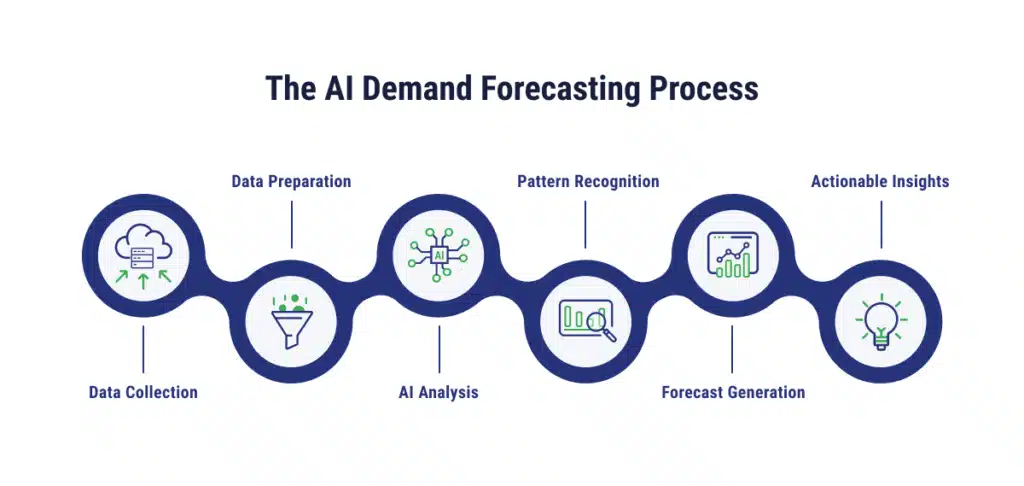
Example of AI Demand Forecasting Process (Source: TierPoint)
Take a practical Singapore example:
A sports retailer might see that running vests sell steadily year-round, but sales spike every August before the Army Half Marathon.
Traditional planning might catch that. But AI can also notice that a particular colourway is getting more early searches on your site, or that similar stores in your category are seeing faster turnover on moisture-wicking fabrics.
That means you can shift orders from standard cotton tees to technical gear before the rush hits. Better demand prediction helps you prepare earlier, order smarter, and avoid last-minute airfreight costs that eat into your margins.
Once you have better demand forecasts, the next natural question is how to balance stock so you’re never caught overcommitted or underprepared.
Reducing Stockouts and Overstocking
This is where AI stock management delivers the most visible wins for Singapore retailers.
A stockout happens when demand exceeds your available inventory. The result? Lost sales and often a permanent dent in customer trust. Overstocking is the opposite problem, cash sitting on shelves while you pay for storage you don’t need.
Let’s put it in local terms. During 11.11 or 12.12, your bestseller might sell out in hours. Without AI, you might not even notice until your customer service team starts getting angry messages.
Meanwhile, overstocking a slow-moving SKU means that precious pallet space in your warehouse could have gone to faster inventory.
AI helps you find balance:
- Continuous sales monitoring: Real-time visibility into velocity
- Lead time tracking: Know exactly when stock will arrive
- Early warnings: Alerts before bestsellers run dry
- Excess flags: Notices when you’ve ordered too much of a slow mover
The goal isn’t zero inventory. The goal is enough stock to meet demand without creating waste.
Achieving that balance also means making smarter decisions about when and how much to reorder. That’s where replenishment gets much more efficient.
Making Replenishment and Purchasing More Efficient
Most teams either reorder on autopilot, same quantities, same schedule, or scramble at the last minute when something runs out.
Neither is efficient, especially in Singapore, where lead times from regional suppliers can vary wildly.
Inventory automation changes that. AI can help you decide:
- When to reorder: Optimal timing based on lead times and demand
- How much to reorder: Quantity suggestions that minimise holding costs
- When demand is rising faster than usual: Catch spikes before they become problems
- When a supplier delay means ordering earlier: Proactive, not reactive
Consider a common local scenario. Your supplier in Thailand often delivers late before the December holiday season because of port congestion.
AI can flag that pattern based on historical data and suggest you place your November order two weeks earlier.
No more rushed decisions. No more paying for express shipping that kills your margins.
The same logic applies to daily replenishment for fast-moving consumer goods. Low-stock alerts become proactive suggestions rather than reactive alarms. That frees up your procurement team to focus on strategic negotiations instead of firefighting.
Better replenishment decisions also become easier when you have clear visibility across every location where your stock sits.
Improving Inventory Visibility Across Locations
If you run multiple stores, warehouses, or fulfilment centres across Singapore, you’ve probably faced this problem. You think you have stock, but you don’t know exactly where.
A customer orders online. Your system says you have three units. But those three units are sitting in a store at Westgate, and nobody thought to transfer them to your main fulfilment hub in Toh Guan.
Supply chain optimisation through AI helps you see stock movement clearly:
- Which location is running low: Prevent localised stockouts
- Which location has excess: Identify transfer opportunities
- Where products are sitting too long: Spot ageing inventory before it becomes waste
For omnichannel retailers juggling Shopback orders, in-store pickup, and warehouse shipping, that visibility is essential.
If one store in the east is running out of a popular item while another in the north has plenty, AI can flag exactly where inventory needs to move. You avoid unnecessary inter-store transfers and reduce the time staff spend hunting for stock.
When visibility improves across locations, another benefit follows naturally. You start wasting less time, less space, and less money on stock that never needed to be there in the first place.
Reduce Waste and Unnecessary Costs
Waste isn’t just about perishable goods, though that’s a huge concern for food and beauty retailers in Singapore’s humid climate. Waste is also:
- Seasonal items that go unsold after Chinese New Year or Christmas
- Slow movers needing steep discounts on Shopee or Lazada
- Excess stock eating up expensive warehouse rent
Smarter inventory planning helps you order closer to actual demand.
You reduce:
- Storage costs: Pay only for the space you actually need
- Unnecessary markdowns: Stop training customers to wait for discounts
- Labour hours: No more managing products that never should have been ordered
A local example:
- A small fashion brand might see AI flag that three styles of linen dresses are forecast to sit for 60 days based on early browsing data.
- Instead of ordering 200 units of each, they order 80 and run a small pre-order campaign. No dead stock. No storage fees eating into margin.
That said, AI isn’t a crystal ball. Relying on it completely comes with real risks, and knowing those limits is just as important as knowing the benefits.
Risks and the Need for Human Oversight
AI can create real problems when the data behind it is incomplete, outdated, or missing important context.
If your sales history is messy, say you changed your POS system six months ago or ran an unplanned promotion that skewed numbers, your forecasts will be messy too.
Here are key risks to watch for in a Singapore context:
- Poor data leads to inaccurate forecasts: Garbage in, garbage out
- AI may miss sudden viral trends until it’s too late
- Supplier changes aren’t always reflected: A Malaysian supplier raising prices or facing flood-related delays
- Unexpected local events break the model: Circuit breaker, haze season, or sudden travel reopening
Over-reliance on automation can also lead to automatic over-ordering or under-ordering. That’s why human oversight still matters most.
Your team knows things AI doesn’t:
- A supplier relationship that’s getting rocky
- A competitor opening nearby
- A customer trend that hasn’t hit the data yet
- Cultural or seasonal nuances AI doesn’t understand
Use AI to flag patterns and suggest actions. But keep your operations and procurement teams in the loop to handle exceptions, catch weird market shifts, and apply real-world judgment.
The best smart inventory systems combine machine speed with human common sense.
Final Thoughts
You’ve seen how AI for smart inventory can transform demand forecasting, reduce stockouts, and improve replenishment decisions. But theory alone doesn’t move inventory. Application does.
At @ASK Training, we help Singapore professionals move from knowing about AI to actually using it. Our Generative AI courses are hands-on, practical, and designed for busy teams who need results, not just concepts.
Newly Launched:
- We launched a dedicated course on (24hrs) AI for Smart Inventory: Predictive Analytics & Optimisation.
- This new programme will dive deep into inventory automation, demand forecasting, and supply chain optimisation specifically for Singapore’s retail and logistics environment.
For Organisations
- We offer customised corporate training programmes tailored to your industry, workflow, and business goals.
- Not sure where to start? We provide a Training Needs Analysis to help identify exactly which AI skills and processes will deliver the biggest impact for your organisation. Book your complimentary 15-minute consultation with us!
Have questions about which course fits your team? Speak to our programme consultants today!
Stop guessing your stock. Start letting AI guide your next move.
Related Courses
- (24hrs) AI Smart Inventory: Predictive Analytics & Optimisation
- (24hrs) AI in Operations: Enhancing Workflow Efficiency & Automation
- (32hrs) AI Driven Sales & Marketing: Boosting Engagement & Conversions
◆◆◆
Related Articles
Article Topics
- What is AI for Smart Inventory?
- Why Smarter Forecasting Matters in Inventory Management
- How AI Helps Predict Demand
- Reducing Stockouts and Overstocking
- Making Replenishment and Purchasing More Efficient
- Improving Inventory Visibility Across Locations
- Reducing Waste and Unnecessary Costs
- Risks and the Need for Human Oversight
- Final Thoughts
Every day, operations teams lose hours to the same invisible drains: scattered information, repetitive data entry, slow approvals, and avoidable errors.
You feel it as a business owner or operations manager, that nagging sense that your team could be doing more if only the processes weren’t working against them.
That’s where AI in operations changes the game.
We’re not talking about science fiction or replacing your people with robots. Instead, think of artificial intelligence in operations as a practical, approachable tool that helps your team work smarter. It handles the routine so your people can focus on problem-solving, customers, and growth.
Let’s explore how AI workflow automation can make your business faster, smoother, and far less prone to daily friction.
What Does AI in Operations Mean?
Simply put, AI in operations means using smart tools to help you organise work, automate repetitive tasks, spot patterns, and make better day-to-day decisions, without needing a computer science degree.
You’re probably already using basic versions of business process automation without realising it. But when you add AI, things get more proactive.
Common uses include:
- Smart scheduling
- Automated reporting
- Inventory tracking
- Task routing
- Document processing
- Customer support triage
Here’s a simple example: Instead of someone manually sorting every incoming customer request, AI automation tools can categorise each ticket, send it to the right person, and even suggest the next step.
The human still handles the conversation, but they waste zero time on sorting.
Why AI Matters in Workflow Efficiency
Operations teams juggle moving parts: people, deadlines, customer expectations, and endless handoffs. When one piece slips, everything slows down.
AI operational efficiency steps in by reducing delays and repeated work.
For instance, instead of someone re-entering data from a form into three different systems, AI pulls those details once and populates them everywhere.
Smoother handoffs become possible, too. Imagine a support call ending, and AI immediately summarises key points for the billing team or flags an urgent order for shipping. That’s workflow efficiency in action.
A quick word of honesty, though: AI won’t magically fix a broken process. If your approval chain already makes no sense, automating it will just make nonsense happen faster. Always fix the process first.
Reducing Repetitive Manual Work
If you ask any operations manager what drains their team’s energy, the answer is almost always the same: repetitive, low-judgment tasks.
One of the clearest benefits of AI process automation is taking those tasks off your team’s plate. Think about:
- Data entry
- Invoice sorting
- Drafting routine reports
- Appointment scheduling
- Document review
- Sending status updates
When AI handles these, your people get time back for real problem-solving and customer-facing work.
That said, always keep a human in the loop for accuracy. AI-generated work should be reviewed when details matter, especially with invoices, compliance documents, or customer communications.
Helping Teams Find Bottlenecks Faster
Here’s a frustrating reality: most teams don’t realise where their workflow slows down until something breaks completely.
AI for operations management changes that by helping you see the delays before they become crises.
AI can flag patterns like:
- Approvals that consistently take too long
- Repeated customer issues from the same step
- Overloaded team members
- Missed handoffs between departments
- Orders getting stuck in processing
Spotting these earlier means you can fix problems while they’re still small.
For example, if customer requests keep stalling at the same approval step every Tuesday afternoon, AI can flag that step as a workflow bottleneck.
You then investigate why, maybe someone is out of office, and adjust accordingly.
Next, how do we help our team make faster decisions once they know what to focus on?
Supporting Faster Day-to-Day Decisions
Have you ever watched a team member spend twenty minutes deciding which task to tackle first? That’s not laziness; it’s a lack of clear signals.
AI in business operations acts as a decision-support tool. It doesn’t make every choice for you, but it gives your team clearer information so they can act faster.
Examples include:
- Identifying which customer requests are truly urgent
- Predicting busy periods so you can prep ahead
- Highlighting low stock before you run out
- Showing which tasks need attention right now
Here’s a practical one: If demand rises every rainy weekend or during certain seasons, AI can help you plan staffing, inventory, or delivery schedules earlier, not after the chaos hits.
Faster decisions naturally lead to another critical area: how you allocate your people, time, and resources in the first place. Because even the fastest decision is wasted if your scheduling is a mess.
Making Scheduling and Resource Planning Easier
Few things hurt operational efficiency more than either idle staff or overwhelmed teams.
In Singapore, where commercial rents and labour costs don’t wait for anyone, AI helps you balance both.
With the right AI automation tools, you can improve:
- Staff scheduling based on predicted demand
- Route planning for deliveries
- Workload balancing across team members
- Inventory planning to avoid overstock or shortages
- Maintenance timing before equipment fails
Consider a local delivery or logistics business as an example. Instead of drivers guessing the best route through Singapore’s expressways and narrow estate roads, AI can suggest more efficient paths, reduce unnecessary travel, and help complete more stops in less time. That’s better for costs, for customers, and for driver sanity.
Better planning also means less last-minute firefighting and fewer rushed errors.
Of course, even the best schedule falls apart if teams aren’t communicating effectively. That’s where AI can act as a bridge, not a replacement, but a smoother.
Improve Communication Across Teams
Operational delays rarely start with someone being lazy. They usually happen because two teams didn’t have the same information at the same time.
Sales doesn’t know what support was promised. Operations doesn’t know what finance approved.
AI workflow automation can bridge those gaps. AI helps by:
- Summarising updates so no one reads ten emails
- Organising incoming requests by department
- Reminding teams of next steps automatically
- Keeping records searchable and easy to find
Handoffs between sales, support, finance, and operations become much smoother.
For instance, when a sales rep closes a deal, AI can automatically notify the onboarding team and create a checklist, without anyone remembering to forward an email.
To be clear: AI isn’t replacing internal communication. It’s just removing the friction that slows it down.
When communication flows better, and schedules make sense, something remarkable happens: both your customers and your employees start having a better experience, without you having to dramatically change what you do.
Enhancing Customer and Employee Experiences
Smooth operations feel invisible to customers, but they feel the absence of friction. Faster responses, fewer errors, clearer updates, and reliable service all come from better backend processes.
When you apply artificial intelligence in operations, customers benefit from:
- Quicker answers to common questions
- Fewer “we’ll get back to you” delays
- Accurate order statuses without chasing
Your employees benefit just as much. Less repetitive work, fewer confusing manual processes, and less time spent asking “who handles this?” means they actually enjoy their day more.
In Singapore’s tight labour market, that kind of employee experience directly impacts retention.
That’s the real win: workflow efficiency isn’t just a metric. It’s the difference between a team that’s exhausted and a team that’s engaged.
All of this probably sounds promising, but you might be thinking: “That’s nice in theory, what does this actually look like for someone like me?”
Examples of AI in Operations
Let’s make this concrete. Here’s how real teams are using automation in operations every day, including scenarios that fit Singapore’s business environment:
- A support team uses AI to sort incoming tickets by urgency so critical issues never sit at the bottom of a pile.
- A warehouse uses AI to predict which items may run low before the end of the month.
- A delivery company uses AI to suggest more efficient routes, cutting fuel costs and delivery times.
- A finance team uses AI to organise invoices and flag missing details before approval.
- A manager uses AI summaries to review project updates faster instead of reading fifteen separate status reports.
- An F&B chain uses AI to predict ingredient demand across multiple outlets, reducing waste and preventing stockouts.
Each example ties back to time savings, fewer errors, or smoother workflows, not fancy technology for its own sake.
How Can AI Help Increase Conversions
Conversions don’t happen by accident. They happen when the right message reaches the right person at the right time.
AI for conversions supports each part of that equation:
- Better timing: Contact interested leads sooner, before they go with a competitor.
- Better relevance: Show content that fits exactly where the customer is in their journey.
- Better follow-up: Reduce response delays and spot exactly where people drop off in your funnel.
That said, AI alone won’t fix bad messaging or a weak offer. It works best when paired with a strong strategy, clear value, and human judgment. Think of it as support for the work you’re already doing.
That all sounds promising in theory. But what does this actually look like in real businesses? Let’s get concrete.
Your Quick-Start Checklist: Applying AI in Operations Today
You don’t need a massive budget or a technical team to get started.
Here’s a practical checklist to help you identify where AI workflow automation can deliver quick wins for your business.
Step 1: Spot Your Top Three Time-Wasters
Look at last week. Which tasks repeatedly ate up your team’s time?
- Manual data entry or copy-pasting between systems
- Sorting and routing customer requests or emails
- Chasing approvals or following up on pending tasks
- Drafting routine reports, invoices, or status updates
- Scheduling meetings or appointments
Step 2: Ask “Does This Need a Human Brain?”
For each time-waster, decide if it requires judgment or just repetition.
- Requires human judgment (strategy, empathy, exceptions) → Keep it human
- Repetitive and rule-based → Good candidate for AI
Step 3: Pick One Small Process to Test
Don’t overhaul everything. Choose a single, contained task.
- Sorting incoming support tickets by urgency
- Summarising long email threads for your team
- Flagging invoices that are missing key details
- Suggesting meeting times based on calendar availability
- Categorising form submissions or survey responses
Step 4: Set a Simple Success Measure
How will you know if it’s working?
- Time saved per day (e.g., “two hours less data entry”)
- Error reduction (e.g., “fewer misrouted customer requests”)
- Faster turnaround (e.g., “approvals cut from one day to one hour”)
- Team feedback (e.g., “my staff feels less frustrated”)
Step 5: Keep a Human in the Loop
Decide when and how your team will review AI-generated work.
- Spot-check a percentage of outputs (e.g., 10% of invoices)
- Review all high-stakes decisions (e.g., refunds or escalations)
- Revisit the process weekly for the first month
Download this quick checklist to help you keep track:
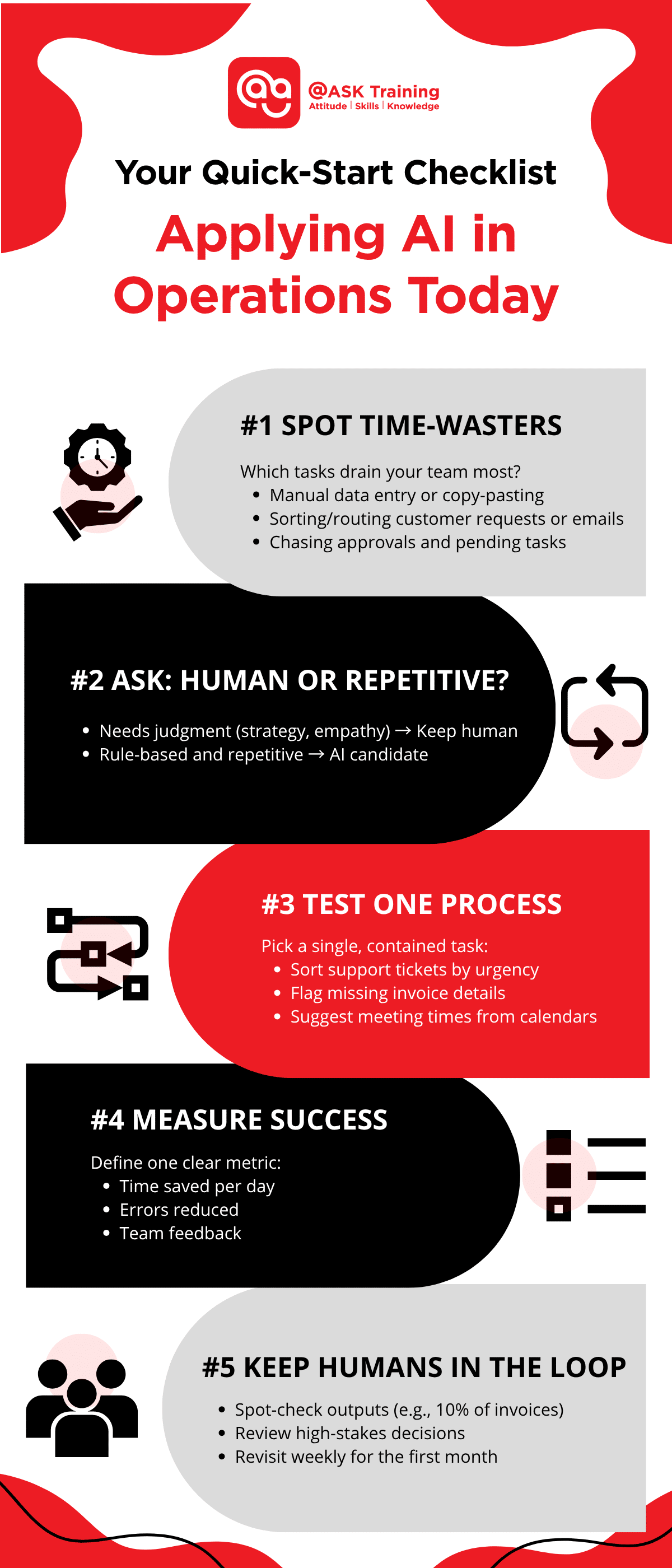
Pro Tip: Start with Built-in Tools
Before buying new software, check what you already use.
Many common platforms (email clients, project management tools, CRM systems) now include basic AI automation tools that are turned off by default.
Turn one on, test it for a week, and see what happens. You might be surprised at how much workflow efficiency you gain from tools you already pay for.
By now, you might be excited to try this yourself, and you should be. But let’s pause for a moment of real talk. AI isn’t a magic wand.
There are real risks if you jump in without thinking, especially with Singapore’s strict data protection landscape under the PDPA.
The Risks of Overusing AI in Operations
We’d be doing you a disservice if we only talked about the upside. AI in operations comes with real risks when teams rely on it without oversight.
Watch out for:
- Inaccurate outputs (AI can be confidently wrong)
- Poor data leading to bad automation
- Confusing automation that creates more work
- Privacy concerns with customer or employee data (particularly relevant under Singapore’s PDPA)
- Employees losing visibility into how decisions are made
Also critical: automating a bad process just makes the problem happen faster. If your return authorisation process is a mess, AI won’t fix it, it’ll just process messy returns at high speed.
Example: If an AI tool routes customer requests using outdated categories, important issues may go to the wrong team for days. That’s worse than no automation at all.
If risks exist, does that mean AI isn’t worth it? Not at all. It just means you need one critical ingredient that no algorithm can replace: human judgment.
Why Human Oversight Still Matters Most
Here’s our firm stance at @ASK Training: AI serves people, not the other way around.
Business process automation still requires judgment, context, flexibility, and accountability; all human strengths. AI can suggest priorities and automate routine steps, but people need to handle exceptions, sensitive decisions, and anything involving relationships.
Teams should always know where AI is being used and feel empowered to step in when something feels off.
In a regulated environment like Singapore’s, where customer data and compliance are non-negotiable, that human oversight isn’t optional; it’s essential.
The best approach? Let AI handle the routine work while your people manage quality, customer relationships, and strategic decisions. That’s not compromise, that’s smart operations.
So, where is all of this heading? Because AI isn’t standing still, and neither should your business.
The Future of AI in Operations
Looking ahead, AI for operations management will only become more embedded in everyday work.
Expect to see:
- More connected workflows across formerly separate systems
- Faster issue detection before customers even notice
- Smarter planning that adapts to real-time changes
- Even more routine tasks becoming automated
For Singapore businesses specifically, this means staying competitive without burning out your teams.
As the government continues pushing Smart Nation initiatives and digital transformation grants, AI adoption will move from “nice to have” to “table stakes” across industries.
The goal isn’t automation for its own sake. It’s businesses becoming more responsive and less weighed down by manual work.
AI in operations delivers real value when it improves the flow across your whole organisation, from the first customer touchpoint to the final delivery.
By now, you probably have a clear picture of what’s possible. Let’s bring this back to where you started: your business, your team, and the daily work that needs to get done.
Wrapping Up
You didn’t build your business to watch your team drown in repetitive tasks, slow approvals, and avoidable errors. AI in operations offers a practical way out.
From reducing manual work and improving accuracy to finding bottlenecks and making scheduling easier, AI helps create smoother, faster, and more reliable operations.
Just remember: AI works best when it supports your people and improves your existing processes, not when it replaces judgment.
Ready to stop fighting your workflows? Start small. Pick one repetitive task from the checklist above, explore AI workflow automation, and see what changes.
Your team (and your customers) will notice the difference!
Ready to Move from Theory to Practice?
Reading about AI is one thing. Applying it effectively to your actual daily operations is another. That’s where we come in.
At @ASK Training, we help Singapore business owners, operations managers, and teams move beyond the hype with practical, hands-on learning.
For Individuals & Teams
- Explore our Generative AI Courses: Learn how to use AI tools for real-world tasks like content drafting, data summarisation, and customer communication.
- Whether you’re new to AI or looking to deepen your skills, our courses are designed for non-technical professionals.
For Organisations
- We offer customised corporate training programmes tailored to your industry, workflow, and business goals.
- Not sure where to start? We provide a Training Needs Analysis to help identify exactly which AI skills and processes will deliver the biggest impact for your organisation. Book your complimentary 15-minute consultation with us!
New Specialised Course
We developed a dedicated course on AI in Operations: Enhancing Workflow Efficiency & Automation, exactly what this article covers.
This newly launched course will walk you through:
- Identifying bottlenecks using AI
- Setting up simple AI workflow automation for repetitive tasks
- Choosing the right AI automation tools for your industry
- Maintaining human oversight and PDPA compliance
Register with us today! Your smoother, faster, more efficient operation is closer than you think.
Related Courses
- (24hrs) AI in Operations: Enhancing Workflow Efficiency & Automation
- Beyond ChatGPT: The Ultimate GenAI Toolkit for Workplace Productivity
◆◆◆
Related Articles
Article Topics
- What Does AI In Operations Mean?
- Why AI Matters in Workflow Efficiency
- Reducing Repetitive Manual Work
- Helping Teams Find Bottlenecks Faster
- Supporting Faster Day-to-Day Decisions
- Making Scheduling and Resource Planning Easier
- Improving Communication Across Teams
- Enhancing Customer and Employee Experiences
- Examples of AI in Operations
- Your Quick-Start Checklist
- The Risks of Overusing AI in Operations
- Why Human Oversight Still Matters Most
- The Future of AI in Operations
- Wrapping Up
Your customers move fast. They browse your website, open an email, scroll through social media, and expect you to keep up.
But when you’re juggling leads, content, and campaigns, keeping up feels impossible.
That’s where AI in sales and marketing changes the conversation.
Artificial intelligence won’t write your strategy or close your deals. However, it can handle the repetitive work, surface the patterns you might miss, and give you back something valuable: time.
Time to focus on your customers, creativity, and the kind of strategic thinking that actually moves the needle.
In this article, we’ll explore practical ways AI-driven sales and marketing help businesses understand customers, personalise communication, and support conversions.
Let’s dive in.
What Does AI in Sales and Marketing Mean?
Let’s keep this simple. Artificial intelligence in sales means tools that learn from customer behaviour, automate routine tasks, and help you make better-informed decisions.
You’ve probably already seen it in action without realising it:
- An email draft that gives you a head start.
- A dashboard that suggests which leads might be worth a call.
- A chatbot answering basic questions while you sleep.
Here’s a practical example:
Instead of guessing which prospects are most interested, AI analyses signals like website visits and email clicks. It surfaces a shortlist.
You still decide who to contact and what to say. But you spend less time digging through data and more time actually selling.
That all sounds useful, but you might be wondering: why does any of this matter right now?
Why AI Is Becoming Important in Sales & Marketing
Customers don’t interact with your business in one place anymore. They jump between your website, LinkedIn, email, chat, and a sales call, sometimes all in the same day.
That’s a lot of information. More than any person can track manually.
AI marketing automation helps teams manage this complexity. It connects customer interactions across channels so you can spot patterns, respond faster, and send messages that actually fit the moment.
The goal isn’t automation for its own sake. IT’s about faster responses, more relevant communication, and less time spent on work that doesn’t require your full attention.
So how exactly does AI help you make sense of all that scattered customer behaviour?
Helping Businesses Understand Customers Better
You already know what customers do. AI helps you understand why.
By analysing patterns in page visits, email opens, product views, and drop-off points, AI reveals hidden needs and concerns.
Maybe visitors keep hitting your pricing page but never book a call. AI flags that signal so you can investigate.
Common questions AI can help answer:
- Is our pricing unclear compared to local competitors?
- Do customers need more social proof or case studies?
- Is the offer confusing for our specific audience?
You still answer those questions. But AI helps you notice the problem that existed in the first place.
Without this kind of support, you might miss that pattern for months. With it, you spot opportunities in days and act on them sooner.
Understanding your customers better is one thing. Turning that understanding into better experiences is another. Let’s explore.
Creating More Personalised Customer Experiences
One-size-fits-all marketing doesn’t work anymore. Customers in Singapore, be it B2B or B2C, expect relevance.
They receive dozens of marketing messages daily. The ones that feel generic get ignored.
AI personalisation helps you move beyond generic blasts to messages that actually fit different audiences.
Examples of AI-powered personalisation:
- A returning visitor sees content related to a product they previously viewed.
- A finance sector lead receives a finance-specific case study (not a general one).
- A cart abandoner gets useful product information instead of another generic discount.
When personalisation feels helpful, not invasive, engagement jumps. And so do conversions.
AI helps you deliver relevance at scale, without forcing your team to manually segment every single message.
Of course, personalisation only matters if you’re reaching the right people in the first place. Your sales team doesn’t need more leads. They need better leads.
Here’s how AI helps with that.
Helping Sales Team Focus on the Right Leads
Nothing drains a sales team faster than chasing cold leads. In Singapore’s competitive B2B landscape, every minute spent on the wrong prospect is a minute lost to a competitor.
AI lead scoring helps change that.
AI analyses which prospects show real interest by looking at signals such as:
- Repeat visits to your website.
- Demo or meeting requests.
- Email engagement rates.
- Company fit with your ideal customer profile.
- Past conversation history.
Your team gets a clearer picture of who might be worth prioritising. Less time hunting. More time with serious prospects.
That said, context still matters. A low-scoring lead might have a personal connection you know about.
A high-scoring lead might not be the right fit for other reasons. AI makes suggestions. Your team makes the final call.
Once you know which leads to focus on, the next question is whether your messages are actually connecting.
Are you saying the right things to the right people? AI can help answer that, too.
Making Marketing Messages More Relevant
You send emails, run ads on LinkedIn and Google, and publish content. But which messages actually work?
AI helps you compare what resonates across different channels. Here’s what that looks like in practice:
- If one email subject line gets twice the opens of another, AI flags that pattern.
- If engagement drops on a particular topic, you notice faster and adjust.
- If a specific ad creative drives more conversions, AI surfaces that insight.
No more guessing. No more waiting for end-of-month reports to tell you what went wrong. Just faster feedback so your marketing stays sharp.
Better messages are important, but they still take time to create. What if you could get back some of the hours spent on repetitive tasks?
That’s where AI saves entire teams from burnout.
Reducing Repetitive Work for the Sales and Marketing Team
Let’s be honest: repetitive tasks eat up too much of your day.
For many Singapore marketing teams, the struggle is real, too many tools, too many manual processes, and never enough time for strategic work.
AI handles more of this than you might expect. Common repetitive tasks AI can assist with:
- Drafting follow-up emails after meetings.
- Summarising sales call notes.
- Organising customer details into your CRM.
- Repurposing a webinar into social posts.
- Answering the same FAQ for the tenth time.
Does that mean you publish without reviewing? No. You still check everything. But you start from a solid draft instead of a blank screen.
That saved time goes back to strategy, creativity, and real customer conversations. That’s where your team adds the most value anyway.
Saving time on internal tasks is one benefit. But what about external conversations, the ones happening with your customers right now?
AI can help there, too, especially when your team isn’t available.
Improving Customer Conversations with AI Chatbots and Assistants
Your customers will not have questions during their 9-to-5. They have questions at 10 PM on a Sunday, or during lunch when your team is offline.
AI chatbots help you respond instantly, even when your team is unavailable. Here’s what they can handle:
- Answering frequently asked questions about pricing or features.
- Recommending resources or blog articles.
- Collecting basic contact information.
- Booking meetings directly into your calendar.
- Routing customers to the right team member.
For complex or sensitive questions, the system hands off to a real person. A pricing question might lead to a pricing resource, a few qualifying questions, and an option to book a sales call. Clean, fast, and helpful.
And your team wakes up to fewer messages waiting in their inbox.
Handling individual conversations is valuable, but AI can also look across hundreds of interactions to spot bigger patterns. Trends you might otherwise miss entirely.
Spotting Trends and Opportunities Faster
What if you could notice a problem before it hurts your pipeline?
AI helps teams spot changes they might otherwise miss. Examples of trends AI can flag:
- Rising interest in a specific product feature.
- Dropping engagement on a usually popular channel.
- Repeated sales objections across multiple calls.
- Popular content topics your audience keeps asking about.
- Slowing deals in a particular stage of your pipeline.
Here’s a real example: If five sales calls this week mention the same concern about setup time, AI can flag that pattern. Now you know there’s an issue.
Your marketing team creates content addressing onboarding concerns. Your sales team adjusts how they set expectations. You act on the insight instead of discovering it months later in a quarterly review.
Faster insight means faster action. And faster action gives you an edge.
Spotting trends is helpful, but the real question is whether all of this actually leads to more conversions. Let’s connect the dots.
How Can AI Help Increase Conversions
Conversions don’t happen by accident. They happen when the right message reaches the right person at the right time.
AI for conversions supports each part of that equation:
- Better timing: Contact interested leads sooner, before they go with a competitor.
- Better relevance: Show content that fits exactly where the customer is in their journey.
- Better follow-up: Reduce response delays and spot exactly where people drop off in your funnel.
That said, AI alone won’t fix bad messaging or a weak offer. It works best when paired with a strong strategy, clear value, and human judgment. Think of it as support for the work you’re already doing.
That all sounds promising in theory. But what does this actually look like in real businesses? Let’s get concrete.
Examples of AI in Sales & Marketing
Let’s make this concrete with real scenarios. These examples work whether you’re a local SME or a regional office in Singapore:
- An e-commerce brand recommends products based on browsing history. Customers find what they want faster. Average order value increases.
- A B2B company identifies leads most likely to book a demo. Sales reps spend less time chasing dead ends and more time closing.
- A marketing team drafts different email versions for different customer segments. Open rates climb without increasing headcount.
- A sales team summarises calls and reviews suggested follow-up points. No more scrambling to remember what was discussed.
- A service business uses a chatbot to answer common questions after hours. Customers feel heard. The team starts each day with fewer backlogged messages.
Real-World Example: Carousell
Carousell uses AI to improve the buying and selling experience, including faster listing creation and smarter item discovery. Its AI-powered “List with AI” feature helps sellers create listings quickly, while buyers benefit from a smoother, more efficient marketplace experience.
(Source: Google Cloud)
Each example ties to a clear business benefit: time saved, better focus, or stronger customer experience.
With all these benefits, it might be tempting to let AI run everything. But that would be a mistake. There are real risks when you rely too heavily on AI without review.
The Risks of Relying Too Heavily on AI
AI is powerful, but it has limits. Using it without review creates problems.
Watch out for these common risks:
- Generic content that sounds flat and unoriginal.
- Inaccurate personalisation based on outdated customer details.
- Robotic messages that feel cold and damage brand trust.
- Privacy concerns from over-collecting or misusing customer data.
- Decisions based on incomplete data that lead you in the wrong direction.
If AI makes the customer experience feel less personal, something has gone wrong. Review the output. Test before you scale. And always ask whether a message sounds like something your brand would actually say.
So if AI has these risks, why use it at all? Because the solution isn’t avoiding AI, it’s keeping humans in the loop. Here’s why human judgment still matters.
Why Human Judgment Still Matters Most
AI can spot patterns. It cannot feel empathy.
AI can draft an email. It cannot understand a customer’s frustration or celebrate their win.
- Human judgment remains essential for:
- Creativity that breaks through crowded markets.
- A strategy that aligns with business goals.
- Trust that builds long-term customer relationships.
- Nuance that AI misses in complex conversations.
- Brand voice that feels authentic, not generic.
AI might suggest which leads look promising, but your team decides the approach. AI might write a first draft, but your team shapes the tone. AI might flag a trend, but your team leads the response.
The best approach lets AI handle repetitive work while people guide the message, build the relationship, and make the strategic calls. Both have a role. Neither replaces the other.
Looking ahead, the teams that get this balance right will have a real advantage. So, what’s coming next?
The Future Possibilities of AI in Sales and Marketing
What’s coming next? Smarter, faster, more connected customer journeys.
Here’s what we’re already seeing on the horizon:
- AI that helps teams anticipate customer needs earlier in the buying cycle.
- Systems that flag prospect interests before a sales call so reps arrive prepared.
- Tools that surface exactly which topics matter most to a specific customer.
- Smarter routing that connects customers to the right person instantly.
The future of AI-driven sales and marketing isn’t just about automation. It’s about better customer experiences, earlier support, and conversations that feel relevant, because your team arrives prepared.
So where does that leave you and your team today?
Wrapping Up
Here’s the bottom line.
AI in sales and marketing helps businesses understand customers, personalise communication, save time on repetitive work, and support conversions.
To summarise:
- AI spots patterns you might otherwise miss.
- AI handles busywork so your team can focus.
- AI supports better timing, relevance, and follow-up.
- But AI works best when it supports people, not replaces them.
Strong messaging, clear strategy, and human judgment still drive results. AI just makes it easier to do your best work.
So, take a look at your current process. Ask yourself:
- Where are you spending time on work that doesn’t need your full attention?
- Where are you guessing instead of knowing?
- Where could a little support make a big difference?
Start there. That’s how you create more relevant, responsive, and remarkable customer experiences.
Ready to Explore Practical AI Strategies for Your Team?
At @ASK Training, we help professionals and teams in Singapore move from theory to practice.
Our Generative AI courses are designed for cross-functional teams, from marketing and sales to HR, finance, and operations.
For marketing and sales teams specifically, we recommend:
- NEW: AI-Driven Sales and Marketing: Boosting Engagement & Conversions – our upcoming course on lead scoring, personalisation, and reducing repetitive work.
- Beyond ChatGPT: The Ultimate GenAI Toolkit for Workplace Productivity: Master 8 powerful GenAI tools, turning AI into your all-in-one productivity powerhouse for workplace tasks.
Explore our courses today! Let’s work smarter, with AI supporting your team, not replacing them.
Related Courses
- (32hrs) AI Driven Sales & Marketing: Boosting Engagement & Conversions
- Beyond ChatGPT: The Ultimate GenAI Toolkit for Workplace Productivity
◆◆◆
Related Articles
Article Topics
- What Does AI in Sales and Marketing Mean?
- Why AI Is Becoming Important in Sales & Marketing
- Helping Businesses Understand Customers Better
- Creating More Personalised Customer Experiences
- Helping Sales Team Focus on the Right Leads
- Making Marketing Messages More Relevant
- Reducing Repetitive Work for the Sales and Marketing Team
- Improving Customer Conversations with AI Chatbots and Assistants
- Spotting Trends and Opportunities Faster
- How Can AI Help Increase Conversions
- Examples of AI in Sales & Marketing
- The Risks of Relying Too Heavily On AI
- Why Human Judgment Still Matters Most
- The Future Possibilities of AI in Sales and Marketing
- Wrapping Up